Greek Herbs & Mediterranean Kitchen
Select a chapter from the sidebar to begin reading.
Introduction
Every cup of tea carries a story—of leaves, of lands, and of the hands that prepared it.
I grew up in Canada, but Greece quickly felt like home — I just haven't found my way back yet. I was eight years old the first time I set foot there, and something settled in me that never left. Years later, I made the decision to return — and the moment I did, I began to notice what was quietly disappearing.
There is a kind of knowledge that lives in older hands. The grandmother who knows which herb to dry and when, which tea to make when someone can't sleep, which plant from the hillside has been used for generations to ease an ache. She learned it the way most things worth knowing are learned — by watching, by being present, by caring enough to ask. But fewer people are asking now. The younger generation has moved on, and so the knowledge sits unshared, waiting for someone to want it.
I found myself drawn to those who still live close to the earth — people who tend their animals and gardens, who measure time by seasons rather than screens. Through them, I found my way to tea. To herbs gathered by hand, to recipes passed through quiet kitchens, to small rituals that once shaped everyday life. What began as curiosity became something I needed to hold onto.
These traditions have rooted themselves into my life now — into my kitchen, my habits, the way I gather with people I love.
But I want to show you something beyond the cup. Most of us have grown up thinking of tea and herbs as something you brew and drink — and there is beauty in that. But these same ingredients have always had a place on the plate too. In a marinade, in a dough, folded into something slow-cooked or drizzled over something fresh. This is not chef's knowledge. It is cultural knowledge — the kind that was once common, that belonged to every kitchen, and that we somehow forgot to keep passing down. This book is about bringing it back. The stories, the benefits, the rituals — and then what you do with all of it when you get up and start cooking.
I hope it makes you want to know more. To reach for an herb instead of a pill, to sit with a cup of something you made yourself, to ask the older woman in your life what she knows before that knowledge is gone — and then to take what she tells you and make something with it. That is what this is for.
My love for tea started to grow a lot more once I found one of my favourite stores in all of Greece. After shopping there numerous times, browsing the huge selection of teas this store had to offer, I made a very good friend.
So to you, Theodoris—thank you for making me fall in love with teas, herbs, and spices.
Chapter 1
More Than a Drink: The Leaf in Your Cup Is Also for Your Plate
For me, the art of tea goes beyond the cup—it's a way of elevating my apothecary and my kitchen at the same time.
I've always loved drinking tea, but even more, I've come to love how it can transform the way we experience food. Every day, we reach for the same spices, the same flavors. In many Greek households, recipes are passed down through generations, prepared the way they've always been. And while there is something beautiful in that tradition, I became curious about how tea could find its place within it.
As I explored this idea, I began incorporating teas into my cooking—infusing them into pastries, weaving them into savory dishes, and even adding them to fresh salads. It made me realize that tea isn't just something we sip from a mug; it's an ingredient, full of depth and possibility.
In this book, I share the recipes I've created and come to love during my years cooking in Greece—dishes that honor tradition while gently reimagining it through the lens of tea.
Chapter 2
Building Your Tea Pantry: A Curator's Guide
When I first started building my tea collection, I was really just interested in the simple benefits. I wanted to create my own apothecary—a little cabinet full of things that could help with digestion, with sleep, with the small ailments of daily life.
I started researching teas the way I research everything: notebooks. I filled page after page with benefits, taste profiles, what paired well with what. Just facts at first. Then I got deeper—tinctures, decoctions, the reasons why certain teas are better for certain things. One notebook turned into several.
As my notebooks grew, so did my apothecary. I added essential oils somewhere along the way (that's a story for another day). Jars multiplied on shelves. I had teas I'd never even heard of a year earlier.
Then one day I looked at my collection and realized: I have more tea here than any one person could ever drink. And everybody I know prefers coffee anyway.
So I started experimenting. I made lemonades. Cold brews. Mixed teas and infused them into soda water until I had something worth serving. Once I mastered those, I moved to syrups. Then cocktails—the most interesting cocktails I'd ever tasted, if I'm being honest.
And then one thing led to another, and suddenly tea was in everything. Dishes. Pastries. Desserts. Drinks. I wasn't just drinking tea anymore—I was cooking with it, baking with it, building entire meals around it.
People started noticing. They'd try something I made and say, "This is so good. It tastes familiar, but different. What did you do?"
And then one day, a yiayia—a real one, old enough to be my grandmother—took a bite of something I'd made and looked up at me. "You cook like my grandmother," she said.
I almost cried right there. Someone had finally seen it. All those notebooks, all those experiments, all that love and effort—she saw it. She tasted it. She called it what it was.
We've been friends ever since.
The Non-Negotiables
These are the ones I reach for constantly. If I could only keep five teas, these would be them.
| Tea | Why It's Essential |
| Dittany | It's where I started, and I still use it most. Lamb, butter, beans—it works everywhere. |
| Rigani (Greek oregano) | You'll use this every single day. Salads, meats, eggs, tomatoes. It's the workhorse. |
| Louiza (lemon verbena) | For when you want lemon without the acid. Syrups, desserts, cocktails, ice cream. |
| Faskomilo (Greek sage) | Gentler than regular sage, so it works in more places. Pork, beans, even panna cotta. |
| Malotira (Cretan mountain tea) | The delicate one. For poached fruit, light syrups, things that need a soft touch. |
With these five, you can make almost every recipe in this book. The others are wonderful—I love them all—but they're specialists. Start here.
The Next Tier
Once you've cooked with the essentials for a while, you'll know which ones speak to you. Then you can start adding:
| Tea | When to Add It |
| Kritamo (rock samphire) | If you love seafood. It tastes like the coast itself. |
| Tsouknida (nettle) | If you're a forager at heart. Free, abundant, and so good in pies. |
| Throubi (summer savory) | If you cook beans often. They need it. |
| Fliskouni (pennyroyal) | If you like a challenge. Use it carefully, but it's unforgettable. |
| Achillea (yarrow) | If you want to feel connected to something ancient. A pinch goes a long way. |
| Dafni (Greek bay) | If you thought you knew bay leaves. You didn't. |
Where to Find Them
In Greece, this is easy. Every town has a shop. Farmers' markets are even better—the theies selling herbs there will tell you everything you need to know if you ask nicely.
Outside Greece, it's trickier but not impossible:
Greek specialty shops in larger cities often carry a good selection.
Online retailers are getting better every year. Look for shops that specialize in Greek products.
Grow your own if you have space. Louiza grows easily. Sage is tough. Dittany is harder but possible.
How to Tell If It's Good
Quality matters. Here's what I've learned:
Smell it. This is the most important test. Good dittany should hit you with oregano and thyme. Good louiza should smell like lemon the moment you open the bag. If it barely smells like anything, it's old. Put it back.
Look at it. You want whole leaves and flowers, not dust. If the bag is full of powder and broken bits, it's been sitting around too long.
Ask where it's from. Dittany from Crete is the real thing. Mountain tea from a specific mountain is better than generic "Greek mountain tea." The more specific, the better.
Check the color. Dried herbs should still have some life—green for rigani, silver for faskomilo, golden for malotira. If everything is brown, it's old.
How to Store Them
Greek theies have been storing herbs forever. Here's what they do:
Keep them whole. Don't crumble until you're ready to use. Whole leaves keep their flavor longer.
Airtight containers. Glass jars with good lids are perfect.
Cool and dark. Not above the stove, not in direct sunlight.
Use within a year. They won't go bad, but they'll get weak.
I keep mine in glass jars on a pantry shelf. Nothing fancy. Works fine.
A Few Things I Learned the Hard Way
Don't buy more than you'll use in a year. I have a drawer full of herbs I was sure I needed. Most of them are now just... brown.
The cheap stuff isn't worth it. Bad herbs taste like nothing. You'll use them once and never again. Pay for quality.
Ask the old women. If you're in Greece and you see a theia selling herbs at a market, buy from her. She's been doing this for decades.
Write down where you got things. When you find something good, remember where it came from. I keep a notebook. Saved me many times.
The One Tool You Actually Need
You don't need a fancy kitchen. A pot, a strainer, a good knife—that's enough. But one thing makes everything easier:
A spice grinder or mortar and pestle.
Grinding dried herbs releases their oils. For butters, for rubs, for anything where you want the herb to disappear into the dish—grind it first. I use a cheap coffee grinder I cleaned out years ago. Works perfectly.
A Final Thought
Building a tea pantry takes time. You don't need to buy everything at once. Start with dittany and rigani. Make the butter. Make the lamb chops. See how you feel.
That yiayia who said I cook like her grandmother—she didn't learn everything in a week. She grew up with it, watched her own mother, gathered year after year. We're catching up. That's okay.
Start small. Cook with love. Pay attention.
And one day, maybe someone will taste your food and see it too.
Chapter 4
Dittany: The Tea I Fell For in a Friend's Tea Shop
The herb that made me realize tea belongs in the kitchen
I walked into my favorite tea shop one afternoon, looking for something different. Not the usual sage or chamomile—I already had those. I wanted something new for my apothecary, something unfamiliar. That's when I found dittany.
When I got home, I opened the tin and took a deep breath in. The aroma hit me immediately—strong and warm, almost like oregano, but with something softer lingering underneath. I brewed a cup the way you would any herb: hot water, a teaspoon or two of dittany, and time to let it steep.
The taste was bold. Not unpleasant—just present. Earthy and warm, with that same oregano-thyme note I had noticed before. And as I sat there drinking it, a thought crossed my mind: This would be really good in a salad. Or even with Dijon mustard.
A strange thought for a tea, maybe. Dijon and tea. But the flavor was so close to something savory that my mind naturally went there.
A few days later, I tried it—sprinkling the dried dittany over a simple salad with greens, olive oil, and lemon. Nothing. The flavor barely came through. It was too delicate, too easily lost among everything else.
So I stood in my kitchen, thinking: How do I taste this without losing it?
Butter. Butter carries flavor without overpowering it. It softens, it holds, it lets ingredients speak instead of competing with them. I could make a dittany butter, spread it over warm bread, maybe add a bit of cheese.
I tried it that same afternoon—softened butter, finely ground dittany, a pinch of salt. I spread it over warm bread and added a few shavings of hard cheese on top. It worked. Really well. That oregano-thyme note was still there, but gentler now, more rounded. The butter smoothed its edges, and the cheese brought just enough salt and richness to bring everything together.
And that's how I started cooking with dittany—not with a recipe, but with curiosity. A cup of tea, a passing thought about mustard, a failed salad, and the quiet realization that sometimes, the simplest solution is the right one.
What It Is
Dittany (Origanum dictamnus) is one of the rarest herbs in the world, native almost exclusively to the mountains of Crete. It grows on steep rocky cliffs and gorges—places that are hard to reach, which is part of why it was so prized in antiquity. The name Erontas—the love herb—comes from the tradition of young men who would risk their lives climbing to gather it for the women they loved.
The plant itself is delicate: soft, downy leaves with small pink flowers, almost woolly to the touch. The scent when you crush the leaves is unmistakable—warm, herbal, somewhere between oregano and thyme with something gentler beneath.
The Benefits of Dittany
The more I cooked with dittany, the more I wanted to know about it. Turns out, people have been loving this herb for a very long time.
In Greece, dittany has been used for centuries—not just in cooking but as a healing plant. The ancient Greeks thought very highly of it. They believed it could heal wounds, soothe stomachs, even help with childbirth.
Digestive support. This is probably its most common use. A cup of dittany tea after a meal helps with bloating and settles things down. I reach for it often when I've eaten a little too much.
Soothes coughs and sore throats. Something about it is calming for the respiratory system. If I feel a cold coming on, I make a strong pot.
Rich in antioxidants. Like a lot of Mediterranean herbs, dittany has compounds that help protect your body from all the things life throws at it.
Anti-inflammatory properties. Traditional use says yes, and some research backs it up. People have used it for swelling and soreness for ages.
Gentle on skin. You can make a strong tea, let it cool, and use it on minor cuts or irritations.
Freshens breath. Chewing a leaf works. Tastes good too.
A note: most of what we know about dittany comes from traditional use and newer studies are still emerging. Think of it as a wonderful herb to cook with and enjoy, not as medicine. If you have something serious going on, talk to a doctor.
How to Use It
A few things I've learned:
Grind it. The flavor is more concentrated and more even when ground. A quick pass in a spice grinder or mortar and pestle is worth the effort.
Don't overdo it. It's assertive. Start with less than you think you need and taste as you go.
Pair it with fat. Butter, good olive oil, cream—dittany loves all of them. Fat carries the flavor and smooths its edges.
Use it in braises and slow cooks. A strong dittany infusion added to lamb or beans as they cook adds a depth that's hard to put into words.
Try it with beans. This surprised me. White beans braised slowly with dittany, a little lemon, and good olive oil—one of the best things I've made.
| Good with | How I use it |
| Lamb | Butter rub, infusion in the braising liquid |
| White beans | Infusion added while they cook |
| Bread | Dittany butter, shavings of hard cheese |
| Potatoes | Roasted with dittany-infused oil |
| Eggs | A pinch in scrambled eggs or frittata |
| Hard cheese | Together as a simple spread |
| Dijon mustard | In a compound butter or sauce |
Recipes
Recipe 1: Dittany-Dijon Butter
Over a steak, over roasted potatoes, or just on warm bread—this butter goes everywhere.
Ingredients:
½ cup softened unsalted butter 2 tbsp Dijon mustard 1 tsp dried dittany, crushed in palm ½ tsp honey Pinch of flaky salt
Method: Place everything in a bowl and beat until creamy. Roll into a log in parchment paper and chill.
If you dare, add 1 tsp of tarragon for a French countryside in spring flavor.
Recipe 2: Dittany Concentrate
For marinades, braises, and sauces.
Ingredients:
1 tbsp dried dittany leaves ½ cup water, just below boiling (95°C / 200°F)
Method: Steep, covered, for 8–10 minutes. Strain through a mesh strainer, pressing on the leaves to extract every drop.
Use in place of wine or stock when braising lamb, pork, or beans.
Chapter 6
Rock Samphire: A Little Taste of the Sea
Kritamo — the sea fennel
I didn't go looking for kritamo. I was at the beach, doing nothing in particular, when something on the rocks caught my eye. A low, dense plant growing right out of the cliff face — thick, waxy leaves, completely unbothered by the salt spray hitting it every few seconds. I took a photo on my phone and looked it up when I got home.
That's how it started.
What I found surprised me. This scraggly plant clinging to the rocks turns out to be one of the most nutritionally dense herbs in the Greek landscape. It has been gathered from Mediterranean coastlines for centuries. And it has a flavor unlike anything else I'd cooked with — salty, aromatic, somewhere between fennel and the sea itself.
What It Is
Kritamo (Crithmum maritimum) — rock samphire, sea fennel — grows on rocky coastlines and sea cliffs throughout Greece and the wider Mediterranean. The name comes from the Greek krithmon, and it has been documented since ancient times: Dioscorides wrote about it, sailors ate it to prevent scurvy, and coastal villages have been pickling it for generations.
There are two versions you will encounter — the coastal plant, which grows right on the rocks where the sea hits, and a land variety found further inland. The coastal one is what you want. It is tougher, more resilient, more concentrated — because it has to be. Growing where saltwater washes over it constantly shapes everything about it.
The leaves are thick and succulent-like, almost architectural. The flavor is bold: aromatic, faintly salty, with that fennel-celery quality that makes it immediately recognizable once you know it.
The Benefits
This is where kritamo genuinely surprised me.
Vitamin C. The coastal variety contains dramatically higher levels of vitamin C than its inland counterpart — reportedly up to 100 times more. This is why sailors once carried it on long voyages. It was scurvy prevention before anyone knew what scurvy was.
Rich in essential oils. The volatile oils in kritamo are what give it that distinct aroma. They also have antimicrobial and antifungal properties — useful both medicinally and, historically, as a natural preservative.
High in minerals. Growing in and around saltwater, kritamo absorbs iodine, calcium, magnesium, and potassium from its environment. It is, in a very real sense, the sea in plant form.
Supports digestion. Like many aromatic Mediterranean herbs, kritamo has carminative properties — it helps with bloating and digestive discomfort. Traditional use across the Mediterranean includes it as a digestive aid.
Antioxidants and flavonoids. Studies on kritamo have found significant antioxidant activity, which contributes to its anti-inflammatory properties.
Supports kidney function. It has mild diuretic properties — traditionally used to help the body flush out excess fluids.
A quick note: kritamo is potent. A little goes a long way, and it should be used in moderation, especially for people with kidney conditions or those on certain medications. Enjoy it as food, not as medicine.
A Note on Pickling
Most people who know kritamo know it pickled — kritamo toursi is a traditional preparation found all over coastal Greece. The pickling preserves it, softens the intensity, and extends the season.
I respect the tradition. But I am not a big pickler. I find something gets lost — that fresh, saline, almost electric quality that makes kritamo worth seeking out in the first place.
So in this chapter, we are not pickling anything.
How to Use It
A few things I have learned:
Use it raw first. Before you cook with it, taste a leaf on its own. That will tell you everything about how much to use and what it will do to a dish.
It already has salt. Account for this. Go lighter on added salt in any dish that includes kritamo.
Olive oil is its best friend. The oil carries and softens the aromatic quality without losing it. Simple preparations work best.
It belongs with the sea. Fish, shellfish, anything that comes from the water — kritamo makes sense there in a way that feels almost inevitable.
It works on a board. Next to good bread, butter, and cheese, kritamo cuts through the richness in exactly the right way.
It is not really a tea. Some people brew it, and there is a tradition of doing so. But this is one herb I think belongs on the plate, not in the cup.
What It Goes With
| Good with | How I use it |
| Fish | Grilled, baked, or pan-fried — kritamo alongside or under |
| Potatoes | Roasted with olive oil and kritamo — the combination is very good |
| Olive oil | Just that, and good sea salt, on bread |
| Butter | Kritamo butter for fish or vegetables |
| Hard cheese | On a board — the salt and aroma cut through the richness |
| Bread | Simple, crusty — lets the kritamo speak |
| Shellfish | Mussels, clams — it belongs near the water |
| Lemon | Brightens it without fighting it |
| Capers | A natural pairing — both are salty, both are coastal |
| Yogurt | Whipped with kritamo as a dip — unexpectedly good |
Recipes
Recipe 1: Kritamo Olive Oil with Sea Salt
The simplest thing. Start here.
This is how I first ate it, and I still think it is one of the best ways. Nothing competes with the herb. You taste exactly what it is.
Ingredients:
A handful of fresh kritamo sprigs, washed Good olive oil Flaky sea salt Warm crusty bread to serve
Method: Lay the kritamo sprigs on a small plate. Drizzle generously with olive oil. Finish with a pinch of flaky salt.
Eat with bread. That is all.
If you want to make it a proper board: add a wedge of hard cheese, some olives, a slice or two of cured meat, and a small dish of good butter. Kritamo holds its own against all of it.
Recipe 2: Grilled Fish with Kritamo and Lemon
Serves 2
Fish and kritamo make obvious sense together. Both come from the same world.
Ingredients:
2 whole fish, cleaned (sea bass, sea bream, or whatever looks good — small whole fish work best here) 4–5 sprigs fresh kritamo 3 tablespoons olive oil Juice of 1 lemon 2 garlic cloves, thinly sliced Flaky sea salt and black pepper
Method:
Score the fish two or three times on each side. Season inside and out with salt and pepper. Stuff the cavity with kritamo sprigs and garlic. Brush the outside with olive oil. Grill over high heat — on a barbecue, grill pan, or under a broiler — about 4–5 minutes per side depending on size, until the skin is charred and the flesh flakes easily. Rest for 2 minutes, then squeeze lemon over the top. Serve with the kritamo that cooked inside still tucked in — it will have softened and perfumed the fish from within.
Good alongside roasted potatoes (see Recipe 3) and nothing else.
Recipe 3: Roasted Potatoes with Kritamo and Olive Oil
Serves 3–4
I tried this on a whim and it became a regular thing. The potatoes absorb the aromatic oils from the kritamo as they roast. By the end, the whole pan smells like the coast.
Ingredients:
700g potatoes, cut into rough chunks 4–5 sprigs fresh kritamo, roughly torn 4 tablespoons olive oil 3 garlic cloves, unpeeled and crushed Flaky sea salt and black pepper Lemon to finish
Method:
Preheat oven to 200°C (400°F). Toss potatoes with olive oil, garlic, salt, and pepper in a roasting pan. Roast for 25 minutes, turning once halfway through. Scatter kritamo over the potatoes in the last 10 minutes of cooking — not before, or it will burn. Finish with a squeeze of lemon straight from the oven.
Serve alongside grilled fish, or just eat them on their own directly from the pan. Both are valid choices.
Recipe 4: Mediterranean Pho with Kritamo and Lamb
Serves 4
I love pho. One of the things that makes it what it is — beyond the broth, beyond the noodles — is the toasted spice mix. Fennel, star anise, cloves, cinnamon. You toast them dry in a pan until the kitchen smells like something ancient and complicated, and then everything that follows makes sense.
The first time I held kritamo in my hand and really smelled it, my mind went straight there. That fennel note. That slightly wild, aromatic quality. And I thought: what happens if I swap the dried fennel seed for this?
What happens is a soup that tastes like Greece and Vietnam had a conversation and decided to agree on something.
This is not traditional pho. It is not traditional Greek food either. It is its own thing — a Mediterranean broth built on the logic of pho, with lamb where the beef would be, potatoes and spaghetti where the rice noodles would be, and kritamo running through the whole thing like a thread that connects coast to kitchen.
For the spice mix:
6–8 sprigs fresh kritamo (or 2 tablespoons dried), used in place of fennel seed 3 whole star anise 4 cloves 1 cinnamon stick 1 teaspoon coriander seeds 4 cardamom pods, lightly crushed
For the broth:
1kg lamb shoulder, bone-in 1 large onion, halved and charred (hold it directly over a gas flame or under a broiler until blackened on the outside — this is key) 1 head of garlic, halved crosswise 2 litres water Salt to taste
To finish:
300g potatoes, peeled and cut into chunks 200g spaghetti, broken in half Fresh kritamo sprigs for serving Lemon wedges Olive oil
Method:
Toast the spice mix. In a dry pan over medium heat, toast the star anise, cloves, cinnamon, coriander, and cardamom for 2–3 minutes until fragrant. Add the kritamo in the last 30 seconds — just enough to warm it and release the oils, not long enough to burn it. Tie everything in a piece of cheesecloth or place in a tea strainer. Build the broth. In a large pot, combine the lamb, charred onion, garlic, spice bundle, and water. Bring to a boil, skim off any foam that rises, then reduce to a low simmer. Cook uncovered for 2 to 2.5 hours until the lamb is completely tender and falling from the bone. The broth should be clear and deep. Strain and season. Remove the lamb and set aside. Discard the spice bundle, onion, and garlic. Season the broth generously with salt. Taste it — it should be complex, slightly aromatic, with that faint coastal note from the kritamo running underneath everything. Finish the soup. Bring the strained broth back to a simmer. Add the potatoes and cook 15 minutes. Add the spaghetti and cook until just done — follow the packet time, then taste. Pull the lamb. Shred the meat off the bone into generous pieces and return it to the pot. Serve. Ladle into deep bowls. Top each one with a few fresh kritamo sprigs, a drizzle of olive oil, and a wedge of lemon on the side.
Eat it the way you eat pho — slowly, with your face close to the bowl.
Recipe 5: Roasted Fennel and Kritamo with Salt Cod and Skordalia
Serves 2–4
When I was growing up, my mother used to slice fennel onto my lunch plate. Raw, just like that — no dressing, no salt, nothing. I was obsessed with it. The crunch of it, the sweetness, the way it sat next to everything else and somehow made it all better.
I still love fennel. And when I started working with kritamo, I kept thinking about the two together — the cultivated sweetness of the fennel bulb and the wild, salty edge of the coastal plant. They are cousins of a kind. Put them next to each other and they seem to recognize each other.
Add skordalia — that thick, garlicky Greek paste that should be on more tables than it is — and salt cod, and you have something that is very Greek, very specific, and very good.
For the fennel and kritamo:
2 fennel bulbs, trimmed and cut into wedges, fronds reserved A generous handful of fresh kritamo sprigs 3 tablespoons olive oil Salt and black pepper Juice of half a lemon
For the salt cod:
400g salt cod (bakaliaros), soaked in cold water for 24–48 hours, water changed several times Flour for dusting Olive oil for frying
For the skordalia:
400g floury potatoes, boiled and still warm 4–6 garlic cloves (start with 4, taste, add more if you dare) 100ml good olive oil 2 tablespoons white wine vinegar Salt to taste Cold water as needed to loosen
Method:
Make the skordalia. Crush the garlic to a paste with a pinch of salt in a mortar. In a bowl, mash the warm potatoes until smooth — no lumps. Beat in the garlic paste, then alternate adding olive oil and vinegar, a little at a time, until you have a thick, creamy dip. Add a splash of cold water if it needs loosening. Taste and adjust the garlic and vinegar. It should be bold. Set aside. Roast the fennel. Preheat oven to 200°C (400°F). Toss the fennel wedges with olive oil, salt, and pepper. Roast for 25–30 minutes until golden at the edges and tender through. In the last 5 minutes, scatter the kritamo sprigs over the fennel. They will wilt and perfume everything around them. Finish with lemon juice out of the oven. Fry the cod. Pat the soaked cod dry. Cut into serving pieces. Dust lightly in flour, shaking off the excess. Fry in generous olive oil over medium-high heat until golden and crisp on both sides — about 3–4 minutes per side. Drain on paper. Assemble. Spread the skordalia across the base of a serving plate. Lay the roasted fennel and kritamo on top. Place the fried cod alongside. Scatter the reserved fennel fronds over everything.
The skordalia should be eaten with everything — smear it on the cod, drag the fennel through it, eat it on its own with bread if there is bread nearby.
Where to Find It
In Greece, kritamo grows wild on rocky coastlines — you will find it if you are near the sea and paying attention. That said, gathering it yourself requires knowing exactly what you are picking. If you are not confident, buy it.
In coastal towns and islands, you will find it at farmers markets and small herb shops, especially in spring and early summer when it is at its freshest.
Outside Greece, look for it in specialty Greek food shops or online. It also grows wild along Mediterranean coastlines in southern France, Italy, and parts of the British coast — so if you are in those places, look at the rocks.
Dried kritamo is available online and holds its flavor reasonably well. It is not quite the same as fresh, but it works in the recipes here.
A Final Note
Kritamo is not the kind of herb that announces itself. You might walk past it a hundred times on a beach path without noticing it. It does not ask for your attention.
But once you know it — once you have tasted that strange, salty, almost oceanic flavor — you start seeing it everywhere. On the rocks below the taverna. Growing out of the wall near the harbour. Sitting in a jar at the back of the market, next to the olives.
It grows where nothing else would bother to grow. Right on the edge, between the land and the sea. That is exactly where the flavor comes from.
Chapter 7
Borage: The Flower That Grew Without Permission
The cucumber flower that goes everywhere
<div align="center">
</div>
It started with a teacup.
Someone gave me a small ceramic tea set — delicate, hand-painted, with these little blue-purple star-shaped flowers all over it. I thought it was the most charming thing. I had no idea what the flowers were. I just knew I loved the way they looked, so I put the set in my apothecary and left it there. Aesthetic purposes. Decoration. Something pretty to look at while I was doing other things.
That was my first encounter with borage. I didn't know it yet.
Then I moved into my house in Ioannina and walked out into the garden for the first time. It was completely overgrown — wild, untended, doing whatever it wanted. And two things were growing absolutely everywhere: purslane and borage. Just taking over, completely unbothered, as if they had been waiting for someone to finally show up and notice them.
I crouched down and looked at the flowers. Small, star-shaped, that same blue-purple I had seen painted on the teacup. And I thought — oh. It's you.
After that I started seeing it everywhere. In Preveza, in Arta, along the roads to Lefkada. Growing out of walls, spilling over fences, appearing in places no one had planted anything. Borage does not wait for an invitation. It arrives, it self-seeds, and then it is simply there — every year, without you doing anything at all.
What It Is
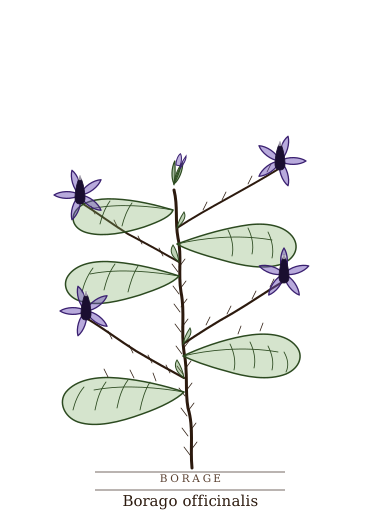
Borage (Borago officinalis) is a Mediterranean herb that has been growing in Greek gardens, fields, and forgotten corners for centuries. The flowers are unmistakable — five-pointed stars, vivid blue-purple, with a dark center that gives them a slightly dramatic look. The leaves are broad and rough, covered in fine hairs.
It is one of those plants that looks like it belongs in a fairy tale and tastes like a cucumber had a very good day.
Once you plant it — or once it finds you, which is more often how it goes — you will always have it. It self-seeds so freely that it essentially becomes permanent. This is either wonderful or overwhelming, depending on how much garden space you have.
The Benefits
Adrenal support. Borage has a long traditional reputation for supporting the adrenal glands — it was known in old herbal texts as the herb of courage, said to lift the spirits and strengthen the heart. Modern herbalists still use it for stress and burnout.
Anti-inflammatory. Borage seed oil is one of the richest plant sources of gamma-linolenic acid (GLA), an omega-6 fatty acid with significant anti-inflammatory properties. The leaves and flowers carry some of this too.
Supports the skin. GLA is also used extensively in skincare — borage seed oil is found in products for eczema, dry skin, and inflammation. The cooled tea makes a gentle skin rinse.
Rich in minerals. Calcium, potassium, iron — borage leaves are nutritionally dense in a way that most decorative flowers are not.
Mood and the nervous system. There is something in borage that has always been associated with cheerfulness. I borage, bring always courage — that old saying has been around since at least the 16th century. Whether it is the GLA, the minerals, or just the act of eating something that blue and beautiful, something seems to work.
Diuretic and cleansing. Borage tea has traditionally been used to support kidney function and help the body release excess fluids.
A note: borage contains small amounts of pyrrolizidine alkaloids, particularly in the leaves. Used occasionally and in normal culinary quantities this is not a concern — but it should not be consumed in very large amounts over long periods. The flowers are the safest part to use freely.
How to Use It
The flowers are the main event. Use them fresh, use them often, use them last — scatter them over a finished dish just before serving.
Keep the dressing light. The flavor is delicate — cucumber-soft, barely there. A heavy dressing will bury it completely. Let it be subtle.
Think cold dishes. Salads, dips, chilled sauces — borage works best when nothing is competing with it at high heat.
Use it in drinks. Frozen into ice cubes, floated in a glass of water or a cocktail — the flower holds its color and its look beautifully.
Young leaves only. The older leaves get rough and more bitter. Pick small, young leaves if you are eating the leaves at all. The flowers have none of that roughness.
Think about campanula. The two flowers are natural companions — similar scale, similar delicacy, similar use. Put them together on a plate and the result is something that looks intentional and rare.
What It Goes With
| Good with | How I use it |
| Cucumber | Natural — they share the same flavor note |
| Yogurt | In tzatziki, in dips, in sauces |
| Fish | As a sauce alongside or scattered over the top |
| Shrimp | With a borage sauce — very good |
| Taro | With a borage-yogurt sauce, earthy and cooling |
| Lettuce and mild greens | In salads where the flower can be seen and tasted |
| Lemon | A light hand — just enough brightness |
| Olive oil | Always |
| Campanula | Together on a plate — two edible flowers, both wild, both blue |
| Gin | Frozen into ice cubes for cocktails — classic |
Recipes
Recipe 1
Borage Salad with Cucumber and a Light Lemon Dressing
Serves 2
The whole point of this salad is restraint. A dressing that gets out of the way. Ingredients that do not compete. And then the flowers on top, doing what they do.
Ingredients:
2 handfuls of soft lettuce leaves — butterhead or little gem ½ cucumber, thinly sliced A small handful of fresh borage flowers A few campanula flowers if you have them — they belong here Optional: a handful of purslane if you can find it
For the dressing:
3 tablespoons good olive oil 1 tablespoon fresh lemon juice A pinch of salt A very small pinch of sugar
Method:
Whisk the dressing together. Taste — it should be clean and simple, nothing dominant. Arrange the lettuce, cucumber, and purslane loosely in a wide bowl or on a flat plate. Dress lightly — you want just enough, not more. Scatter the borage and campanula flowers over the top last. Do not toss them in. Let them land where they land. Serve immediately.
The flowers will not taste like much. That is fine. They are doing something else.
Recipe 2
Borage Tzatziki
Serves 4 as a dip or side
Tzatziki is one of those things everyone thinks they know how to make until they taste a really good one. The borage does not transform it — it just adds something. A faint cucumber note that deepens the existing flavor, and those flowers on top that make the whole bowl look like it came from somewhere special.
Ingredients:
500g thick Greek yogurt — strained, the real thing 1 cucumber, grated and squeezed completely dry 2–3 garlic cloves, crushed to a paste 2 tablespoons good olive oil, plus more to finish 1 tablespoon white wine vinegar Salt to taste A small handful of young borage leaves, very finely chopped Borage flowers to finish
Method:
Combine yogurt, grated cucumber, garlic, olive oil, and vinegar in a bowl. Mix well. Stir in the finely chopped borage leaves. They will disappear into the tzatziki — you will taste them more than see them. Season with salt. Taste and adjust the garlic and vinegar. Transfer to a serving bowl. Drizzle olive oil over the surface. Scatter borage flowers on top just before serving.
Serve cold, with warm bread, alongside grilled fish or shrimp. It also works as a sauce — see below.
Recipe 3
Shrimp and Taro with Borage Sauce
Serves 2–3
This one came from a simple thought: borage tastes like cucumber, cucumber goes with yogurt, yogurt goes with everything. And taro — that thick, starchy root that Greek grandmothers have always known what to do with — needed something cooling and aromatic alongside it.
The result is a plate that feels Mediterranean in a way that is hard to explain but easy to eat.
For the taro:
500g taro root, peeled and cut into chunks (wear gloves when peeling — raw taro irritates the skin) Salt Olive oil
For the shrimp:
300g large shrimp, peeled and deveined 2 tablespoons olive oil 2 garlic cloves, minced Salt, pepper, and a pinch of chili flakes Juice of half a lemon
For the borage sauce:
200g thick Greek yogurt 1 small handful young borage leaves, very finely chopped 1 tablespoon olive oil 1 teaspoon lemon juice Salt to taste Borage flowers to finish
Method:
Cook the taro. Boil the taro chunks in well-salted water for 20–25 minutes until completely tender. Drain, drizzle with olive oil, and season. Keep warm. Make the sauce. Stir together yogurt, chopped borage leaves, olive oil, lemon juice, and salt. Set aside in the fridge. Cook the shrimp. Heat olive oil in a pan over high heat. Add garlic and cook 30 seconds. Add shrimp and cook 2 minutes per side until pink and just done. Season with salt, pepper, and chili flakes. Finish with lemon juice off the heat. Assemble. Spoon the borage sauce across the base of a serving plate. Pile the taro in the center. Arrange the shrimp on top and around. Finish with borage flowers scattered over everything.
The sauce is cold, the taro and shrimp are hot — that contrast is part of the dish.
A Word on Campanula
Borage and campanula are natural companions — both are small, both are blue-purple, both are edible flowers that most people have never thought to eat. Whenever I use borage in a salad or on a plate, I reach for campanula if I have it. Together they create something that looks considered and wild at the same time.
The campanula adds a faint sweetness where the borage adds a faint coolness. They do not compete. They just make the plate more beautiful and, quietly, more interesting.
Where to Find It
Once you plant borage, the question stops being where to find it and becomes how to manage it. It self-seeds so freely that one plant becomes ten, ten becomes fifty. It comes back every year without you doing anything.
If you do not have a garden: look for it at Greek farmers markets in spring and early summer. Specialty herb shops carry dried borage. The flowers can sometimes be found at florists who stock edible flowers.
Outside Greece, borage is easy to grow in any temperate climate. Buy seeds, plant once, and it will find its own way from there.
A Final Note
I still have the teacup set. It sits in my apothecary where I put it when I first received it, next to the jars and the oils and everything else I have collected over the years.
I understand it now in a way I did not then. Those little painted flowers were not just decoration. They were a plant I would find taking over my garden, growing along every road I drove, appearing in every place I was not looking for it.
Borage does not wait to be invited. It just shows up and makes itself at home.
I respect that.
Chapter 8
Campanula: The Flower Someone Gave Me
The bell flower of Crete
It came in a bunch of wildflowers. Someone handed them to me — the kind of casual gift you get in Greece, a handful of things picked from somewhere on the way — and among them was this small bell-shaped flower, purple and delicate, nodding slightly at the top of its stem.
I thought: what a pretty little thing. And then I put the bunch in water and didn't think much more about it.
That's how campanula entered my life. Not through a tea shop, not through a market, not through a yiayia with a story. Through a bouquet.
It was only later, when I was deep in research on Cretan herbs, that I came across it again. And I realized the cute little flower sitting in my vase had a history — and a use — I hadn't considered.
What It Is
Campanula (Campanula spp.) — the bell flower — takes its name from the Latin campana, meaning bell. Look at the flowers and the name makes immediate sense. They hang in clusters, small and perfectly formed, in shades of purple, blue, and white.
Several species are endemic to Crete, growing in the rocky hillsides and mountain terrain that define the island's interior. They are part of what makes Cretan flora distinct — plants that evolved in isolation, shaped by that specific landscape, found almost nowhere else.
In the culinary world, campanula is used almost exclusively as decoration. A flower placed on top of a dish, a garnish on a dessert plate, something that makes food look like it came from somewhere intentional. Beautiful, yes — but that always felt like a waste to me.
The Benefits
The more I read about campanula, the more I understood why it had been used in traditional herbal practice for centuries.
Soothes the throat and respiratory tract. This is its most documented traditional use — an infusion of campanula was used for sore throats, hoarseness, and coughs. The mucilaginous quality of the plant coats and calms irritated tissue.
Anti-inflammatory properties. Like many wild Cretan herbs, campanula contains compounds that help reduce inflammation — useful both internally and, in traditional practice, applied externally to skin irritations.
Rich in vitamins and minerals. The leaves and flowers contain vitamin C, calcium, and various antioxidants. Not the most dramatic nutrient profile among the herbs in this book, but solid.
Mildly calming. Some traditional uses suggest a gentle calming effect — campanula tea was sometimes given for anxiety and restlessness. Nothing dramatic, but something.
As tea: It can be brewed — a mild, slightly sweet infusion, gentle enough for children. But honestly, this is one herb I find more interesting on the plate than in the cup.
How to Use It
As a garnish, yes — but thoughtfully. Don't just drop a flower on a plate. Put it somewhere it interacts with the other flavors, where its sweetness and color actually mean something.
In salads. This is where I landed. The flowers add visual beauty and a quiet sweetness that works surprisingly well against sharper dressings.
The leaves too. Young campanula leaves are edible and have been eaten in Crete as a wild salad green for generations. Mild, slightly sweet, tender when young.
With fruit. The sweet floral quality pairs naturally with fruit — in salads, in desserts, with anything that leans toward sweetness rather than savory.
What It Goes With
| Good with | How I use it |
| Salad greens | Mixed in — adds beauty and a whisper of sweetness |
| Green apple | The sweetness of both works together |
| Cucumber | Cooling, lets the flower speak |
| Purslane | A natural pairing — both are wild, both are Greek |
| Fruity vinegars | Mango balsamic, raspberry — match the floral note |
| Soft cheese | On a board, as decoration that also gets eaten |
| Honey | Drizzled over, in tea, with dessert |
| Lemon | A light hand — just enough to brighten |
Recipe
Campanula Salad with Green Apple and Mango Balsamic
Serves 2
This is the salad I make when I want something that looks like it was thought about more than it was. The campanula flowers do most of the work visually. But the combination underneath them — the apple, the celery, the purslane, that mango balsamic dressing — is genuinely good on its own.
The flowers are not just decoration here. They are part of the dish.
Ingredients:
2 handfuls of romaine or mixed lettuce leaves ½ cucumber, thinly sliced 2 stalks celery, sliced ½ green apple, cored and thinly sliced A handful of purslane (glystrida), if you can find it A small handful of campanula flowers — as many as you have
For the dressing:
3 tablespoons good olive oil 1½ tablespoons mango balsamic vinegar Salt and black pepper
Method:
Whisk the olive oil and mango balsamic together with a pinch of salt and pepper. Taste — it should be fruity, slightly sweet, with enough acidity to hold the salad together. Combine the lettuce, cucumber, celery, apple, and purslane in a wide bowl. Dress and toss gently. Scatter the campanula flowers across the top last — don't toss them in, let them sit where they land. Serve immediately.
The green apple is important. Don't skip it. It gives the salad a crunch and a brightness that makes everything else make sense.
A Note
This is a chapter I am still writing — not just on the page, but in the kitchen. Campanula is a herb I came to almost by accident, and I have not yet spent enough time with it to know everything it can do.
What I know is this: it is beautiful, it is edible, it is sweeter than you expect, and it deserves to be eaten rather than just admired.
The rest, I will discover when I am back in Crete.
Chapter 12
Louiza, Also Known as Lemon Verbena: The Fool's Lemon
The lemon that doesn't curdle your cream
I didn't mean to discover louiza. I was looking for something else.
I had run to the grocery store in a hurry—the way you do when you realize you're out of something and need it now. My list said lemon balm. That's what I went in for. But the shelves were crowded, I was distracted, and somehow, I grabbed lemon verbena instead.
I didn't even notice until I got home and unpacked the bag. I stood there, staring at the package, a little annoyed with myself. Lemon balm was what I needed for the tea I had planned. This was... something else.
I almost pushed it to the back of the cabinet and forgot about it. But the kettle was already heating. And I thought, I'm here—might as well try it.
While the water boiled, I pulled out my phone and started reading. Everything said the same thing: lemon verbena has a soft, gentle lemon scent. Not sharp, not bitter—just sweet and calming. People drink it for digestion, for sleep, or simply because it tastes good.
I opened the package and leaned in. And suddenly, I was on vacation again—driving with the windows down on the road to Arta, passing orchard after orchard in spring. Lemon blossoms, orange blossoms—heavy, sweet, almost intoxicating—pouring into the car like someone had opened a door to somewhere beautiful.
That's what louiza smelled like.
I poured the hot water over the leaves and let it steep. As I waited, I caught myself thinking: This probably doesn't need honey. This might be perfect on its own.
I was right. The first sip was soft, bright lemon—warm and full, without a trace of bitterness. Just something gentle and familiar. Like sunlight, held in a cup.
And then my mind did what it always does—it went straight to the kitchen.
Lemon flavor without the acidity. Do you know how many doors that opens?
Lemon juice is incredible, don't get me wrong. I use it all the time. But it's sharp. It curdles milk, breaks sauces, demands that you work around it. Louiza doesn't do any of that. It gives you lemon—real, recognizable lemon—without the edge. You can steep it in cream for ice cream without worrying about curdling. You can make a syrup for cocktails that carries the flavor without the bite. You can fold it into desserts that would never survive actual lemon juice.
I sat there finishing my tea, already thinking ahead—ice cream, syrups, cakes, things I hadn't even tried yet. All because I grabbed the wrong package at the grocery store.
What It Is
Louiza (Lippia citriodora)—lemon verbena—is originally from South America. Spanish colonizers brought it to Europe in the 17th century, and somehow it just... took off in Greece. The climate suited it, the soil suited it, and Greeks started growing it in their mountain villages like it had always been there. Nowadays, you'll find it everywhere—in tea shops, in home gardens, in little bundles at farmers' markets. Most Greeks think of it as their own. And honestly? After a few hundred years, maybe it is.
The leaves are long and pointed, and when dried, they hold that incredible lemony scent for ages. The essential oil is used in perfumes, in liqueurs, in all kinds of things. But I just want to cook with it.
The Benefits of Louiza
I started researching louiza the way I research everything: I fell down a rabbit hole. And what I found surprised me.
Rich in antioxidants. The same antioxidants that make green tea famous? Louiza has them, but without the bitterness.
Supports heart health. The vitamin C alone helps prevent coronary heart disease, but there's more going on. Anti-inflammatory, antioxidant—the compounds in louiza work on all kinds of things.
Reduces oxidative stress. The compounds help protect against the kind of cellular damage that comes from just living—from exercise, from stress, from being in the world. One study even found that louiza protects cells from exercise-induced muscle damage in healthy men. Athletes drink this stuff for a reason.
Supports joint health. People who drink it regularly say it improves joint function. Not magic—just a little help, a little less stiffness.
Soothes digestion. Louiza has antispasmodic properties, which means it relaxes your gastrointestinal tract. When your stomach is cramped, when you're bloated, when irritable bowel syndrome decides to make your life difficult—louiza helps. It soothes. It settles things down.
Antimicrobial properties. The essential oil has been shown to be effective against certain bacteria, including staph infections.
Supports weight control and blood pressure. And detoxification—it helps the body eliminate free radicals, which boosts immunity.
So what started as a happy accident—grabbing the wrong package at the grocery store—turned out to be a pretty lucky mistake.
How to Use It
A few things I've learned:
It's strong. You don't need much. A few leaves in a pot of tea is plenty.
Heat is your friend. Unlike some delicate herbs, louiza loves heat. Infuse it into warm milk, cream, or syrup—that's where it shines.
It's amazing cold. Iced louiza tea is one of the most refreshing things I know.
It loves honey. The two together are just... right.
It doesn't need sweetener. That first cup taught me—louiza is sweet on its own. Honey is optional, not required.
| Good with | How I use it |
| Cream / milk | Infused for ice cream, panna cotta, custards |
| Honey | In tea, in glazes, drizzled over everything |
| Cocktails | Syrup base for gin and vodka drinks |
| Sparkling water | Louiza syrup + lemon + bubbles |
| Cakes | Soaking syrup for sponge cakes |
| Stone fruit | Poached peaches or apricots in louiza syrup |
| Lemonade | Made with louiza concentrate instead of juice |
| Yogurt | A few leaves steeped in the cream before folding in |
Fliskouni
The Mint You Have to Find Yourself
Basilia didn't make me a cup.
She was my neighbour in Apollona, and some of the best moments from that whole trip were spent at her kitchen table, next to her fireplace, eating sweets she'd brought home from the bakery where she worked — always more than I could finish, always offered like there was no option to refuse. She'd sit across from me and talk. Stories about growing up, about the village, about things she'd lived through that I'd never think to ask about. I didn't need to ask. I just had to show up and she'd start talking, and I'd eat another sweet, and the fire would be going, and time would do something different there than it does anywhere else.
At some point she mentioned fliskouni. The word first, then what it was, then that it grew nearby. She said it the way she said everything — like it was obvious, like of course I should know this. And then that was it. The conversation moved on.
I went out one afternoon toward the olive trees. I wasn't going anywhere specific — just the xorio, the dirt, picking up whatever flowers caught my eye to put in a jar back at the house. At some point I brushed against something and stopped. I knew that smell. I crouched down and looked, and there it was. I hadn't been searching for it, but I recognised it immediately — because she'd told me to.
I picked some, brought it home, dried it, and when it was ready I made a cup. One sip and I knew exactly what I had: spearmint. Clean, bright, completely direct. I'm a peppermint person — I like that cool, slightly sharp edge — but I'd found this myself and dried it in my own kitchen, and that changes how you taste something. You stop evaluating. You just drink it.
Then I started wondering what else it could do.
What It Is
Fliskouni (φλισκούνι) is wild mint. The mint that grows in Crete and across the Mediterranean without anyone planting it — on hillsides, along paths, near water. You smell it before you see it, if you happen to brush against it.
The flavor sits close to spearmint: bright, green, clean. Not the sharp menthol of peppermint, but not neutral either. It has presence. In Greek cooking it's the mint that goes into greens pies, into bean soups, alongside vegetables — the herb that lifts things. Dyosmos is its near-relative and the names get used interchangeably depending on where you are. In Crete, fliskouni. In Athens, dyosmos. Same idea.
Why It's Good for You
Mint has always been a digestive herb — the thing you drink after a heavy meal, the thing you reach for when something isn't sitting right. Fliskouni has a long history in Cretan folk medicine specifically: stomach complaints, headaches, general tonic use. The tea was practical before it was pleasant.
It's anti-inflammatory, antimicrobial, and contains rosmarinic acid and antioxidants. If you've ever had mint tea after dinner and felt genuinely better, that's not imagination. The effect is real.
One note: If you're pregnant, treat fliskouni as a cooking herb — normal amounts in food are fine — and skip the medicinal tea. As with any herb used in quantity, moderation matters.
How to Use It
More ways than you'd expect.
As tea: Dry it, steep it three to four minutes in just-boiled water. It tastes like spearmint — clean and straightforward. Drink it after dinner.
As a syrup: Equal parts water and sugar, brought to a simmer with a big handful of fresh leaves, then left to steep off the heat. The base for margaritas, for strawberry lemonade, for anything that needs brightness without weight. Make it once and you'll keep making it.
In savory cooking: This is where Greek cooks have always known what to do with it. Into greens pies. Into fasolada — the mint cuts through the weight of the beans in a way that makes the whole pot taste cleaner, more alive. Alongside vegetables, eggs, fish. Anything that needs lifting.
Pairings
| Works well with | Notes |
| Feta or burrata | Feta for salt and structure; burrata for something softer |
| Lemon | Always |
| White beans | Classic — mint in fasolada makes the whole pot taste brighter |
| Watermelon | One of the best things you can do with both |
| Mango | Handles the sweetness well |
| Strawberry | Especially in syrups and drinks |
| Salmon | The mint lifts it; works warm or cold |
| Lamb | Use it carefully — it works, but it's not the default Greek move |
| Eggs | A small handful in a scramble or omelette |
Recipes
Watermelon and Mango Salad with Fliskouni and Mango Balsamic Glaze
A summer salad that doesn't need much from you. The fruit does the work. Fliskouni keeps it from being just a fruit plate, and the mango balsamic pulls everything together. Feta if you want salt and structure. Burrata if you want something more yielding. Both are correct.
Serves 4
½ small watermelon, cut into rough chunks or slices
2 ripe mangoes, peeled and sliced
A generous handful of fresh fliskouni (or spearmint) leaves
2–3 tablespoons mango balsamic glaze
150g feta, crumbled — or 1 ball of burrata, torn open
Flaky sea salt
Arrange the watermelon and mango on a wide plate or shallow bowl. Scatter the mint over the top. Drizzle the mango balsamic glaze over everything. Add the feta or burrata. Finish with a pinch of flaky salt.
Eat it immediately. This one doesn't wait.
Green Bean, Asparagus and Cabbage Salad with Fliskouni, Lemon and Feta
A good side on its own, and particularly good next to salmon. The vegetables are cooked but not overcooked — you want them to still have something to say. Serve it slightly warm or at room temperature.
Serves 4
200g green beans, trimmed
200g asparagus, woody ends removed, cut into thirds
¼ green cabbage, finely shredded
A large handful of fresh fliskouni (or spearmint) leaves, roughly torn
150g feta, crumbled
Juice of 1 lemon
3 tablespoons good olive oil
Salt and black pepper
Bring salted water to a boil. Blanch the green beans for 3 minutes, add the asparagus, cook another 2 minutes. Drain and run briefly under cold water — stop the cooking, but keep the warmth.
In a large bowl, combine the cabbage with the lemon juice, olive oil, and a pinch of salt. Let it sit a few minutes — the acid softens it slightly.
Add the beans and asparagus. Add the mint. Toss and taste — more lemon, more salt, more oil if it needs it. Pile onto a plate and crumble the feta over the top.
Hortopita with Fliskouni
Hortopita is the honest version of spanakopita. Where spanakopita is mostly spinach, hortopita uses whatever wild greens you have — that's the whole point. Fliskouni belongs here. It's the herb that tightens the filling and makes it taste like it came from somewhere specific.
Makes one 30cm round or rectangular tray
For the filling:
500g mixed greens (spinach, chard, wild greens if you can find them) 200g feta, crumbled 2 eggs A large handful of fresh fliskouni (or spearmint), finely chopped 2 spring onions, finely sliced 2 tablespoons olive oil Salt and black pepper
For the pastry:
8–10 sheets filo pastry Olive oil for brushing — be generous
Wash and wilt the greens in a pan with a splash of water. When they've collapsed, take them off the heat, let them cool, then squeeze out as much water as you can. This step matters. Wet filling makes wet pastry.
Roughly chop the greens and combine in a bowl with the feta, eggs, mint, spring onions, and olive oil. Season with black pepper and taste before adding salt — feta is already doing that work.
Heat the oven to 180°C. Oil your tray. Lay down sheets of filo, brushing each with olive oil as you go and letting the edges hang over the sides. Use about half the sheets for the base. Spread the filling evenly. Fold the overhanging edges in, then layer the remaining filo on top, brushing each sheet with oil and tucking the edges down.
Score the top lightly — it helps it cut cleanly later. Brush with oil, sprinkle with a little water to help the top crisp.
Bake 40–45 minutes until golden. Let it sit 10 minutes before cutting.
Fliskouni Syrup
(for margaritas, strawberry lemonade, or anything that needs brightness)
The simplest thing in this chapter. Make it once.
Makes about 300ml
200ml water
200g white sugar
A very large handful of fresh fliskouni (or spearmint) — don't hold back
Combine water and sugar in a small saucepan over medium heat. Stir until the sugar dissolves. Add the mint, press it down gently, and let it steep off the heat for 20–30 minutes. Longer means stronger.
Strain into a clean jar or bottle. Keeps in the fridge for 2–3 weeks.
For a fliskouni margarita: 2 parts tequila, 1 part lime juice, 1 part fliskouni syrup. Shake with ice, serve over ice, salt rim if you want it.
For strawberry lemonade: Blend fresh strawberries, add lemon juice, thin with cold water, sweeten with the syrup. Adjust until it tastes like itself.
Where to Find It
In Crete and most of rural Greece, you'll find it growing. Walk anywhere that isn't pavement and pay attention to what smells like mint when you brush past it.
Outside Greece, look at Greek or Mediterranean grocers — sometimes labeled dyosmos or wild mint. Fresh spearmint from a good greengrocer is the right substitute. Not dried, not peppermint. The flavor is close enough.
Grow it if you have outdoor space. Mint spreads aggressively, which is a problem or a gift depending on how you feel about abundance. Pot it if you want to contain it. Give it water. It will not let you down.
A Closing Note
Basilia didn't make me a cup. She sat me by her fireplace, fed me sweets, and told me the word. The rest I had to go find myself.
The tea tastes like spearmint. It's not a revelation. But I picked it from the ground in Apollona while I was just wandering, dried it in my kitchen, made the cup — and that's not nothing.
In Crete, that seems to be how it goes. Someone names the plant. You go find it. The rest is up to you.
Chapter 14
Oregano: The Herb That Doesn't Ask for Credit
The one that was always there, in everything, making it work
Oregano is like paint to a painter. Not the brush, not the canvas — the paint itself. Take it away and you have nothing. You have a blank surface.
That is oregano in my kitchen. In my mother's kitchen before that. Remove it and the dish is still technically a dish — but it is bland, and it is boring, and something is wrong with it even if you cannot say exactly what.
My mother used it in everything. Not as a choice — as a reflex. The way you reach for salt. The way your hand already knows where the pan is before you look. Oregano went into the dish and the dish became what it was supposed to be. There was no version of the dish without it. There was just the dish.
I grew up not thinking about oregano at all. That is how well it did its job.
Now I have a plant. It sits outside and I refuse to give it the attention it probably deserves, and it does not care. Of all the plants I have ever neglected, oregano is the only one that responds to neglect by thriving. Forget to water it — fine. Ignore it for two weeks — fine. Come back and the thing is just there, full and green and unbothered, waiting quietly for you to need it again.
There is something in that I respect enormously.
The smell when I rub a leaf — that is home. Not a memory of home. Home itself, distilled. Oregano takes me there before I have even finished the thought.
What It Is
Oregano (Origanum vulgare) is one of the defining herbs of the Mediterranean, and particularly of Greek cooking. The name comes from the Greek oros (mountain) and ganos (joy, brightness) — mountain joy. The Greeks named it well. It grows wild on hillsides throughout the region, dried by the sun and the wind until it becomes concentrated and potent in a way that cultivated oregano rarely matches.
There are many varieties. Greek oregano (Origanum vulgare subsp. hirtum) is considered the most aromatic and is the one behind most of what the world means when it says oregano. It is stronger than Italian varieties, more peppery, with a warmth that sits at the back of the throat. Dried Greek oregano is one of the great ingredients in the world. It is used fresh too — but this is a herb that, unusually, can be argued to be better dried than fresh in many applications. Drying concentrates the volatile oils and intensifies the flavor.
Marjoram is its close relative — sweeter, softer, more floral. They are sometimes confused and sometimes used interchangeably, but they are different. Oregano has an edge. Marjoram is polite. Know which one you have.
The Benefits
Oregano has been used as a medicinal herb for as long as people have been writing things down. What modern research has found is that the traditional uses were largely correct.
Antimicrobial. This is oregano's most studied property. The essential oil — particularly carvacrol and thymol, the main active compounds — is powerfully antimicrobial. Studies have shown it effective against a wide range of bacteria, including some antibiotic-resistant strains. Oregano oil is used today as a natural antimicrobial supplement, and the research behind it is serious.
Antioxidant. Oregano has one of the highest antioxidant concentrations of any culinary herb — significantly higher than most fruits and vegetables. The rosmarinic acid and other polyphenols it contains fight oxidative stress throughout the body.
Anti-inflammatory. Carvacrol and thymol are also anti-inflammatory. Regular consumption — meaning using oregano regularly in cooking, which Mediterranean populations have always done — contributes to lower systemic inflammation over time.
Immune support. The antioxidant and antimicrobial properties together make oregano a genuine immune-supportive herb. It was used traditionally during illness, in teas and preparations, to support recovery. This was not superstition.
Digestive health. Like many Mediterranean herbs, oregano supports the digestive system — stimulating the production of bile, supporting gut health, reducing bloating. It earns its place in heavy, rich dishes.
Vitamins and minerals. Fresh oregano is a source of Vitamin K, Vitamin E, iron, calcium, and manganese. Dried is more concentrated still. These are not trace amounts — oregano used generously in cooking delivers real nutritional value.
Antifungal. Oregano oil and its compounds have demonstrated antifungal properties in research settings. Traditional use as a remedy for gut-related fungal issues has some scientific backing.
How to Use It
Dried in marinades. This is one of oregano's highest callings. Dried oregano rubbed into meat, mixed with olive oil and lemon — this is the foundation of Greek cooking. Let it sit. Let it do its work.
Fresh on salads. Fresh oregano is more assertive than most people expect — use it with confidence. It can carry a salad by itself.
In sauces and stews. Add dried oregano early to give it time to bloom in the fat and liquid. Add fresh toward the end for brightness.
On grilled things. After something comes off the grill, scatter fresh oregano. The heat of the food opens the leaves and releases the oils.
In anything with lemon and olive oil. This is the holy trinity of Greek cooking. Oregano is always the third part.
Fresh versus dried. I prefer to have fresh oregano in the house — but dried is the staple, and there is no shame in it. For dishes with heat and time, dried is often better. For anything fresh and bright, use the plant.
What It Goes With
| Good with | Why |
| Lemon | The classic — acid sharpens oregano and they elevate each other |
| Olive oil | Inseparable — the fat carries the aromatic compounds |
| Garlic | Together they form the base of almost everything |
| Lamb | The natural pairing — no lamb dish is complete without it |
| Chicken | In a marinade, under the skin, over the top |
| Fish and shrimp | Particularly with lemon — brightens without overpowering |
| Tomato | The Italian and Greek instinct is correct — oregano and tomato are made for each other |
| Feta | On a salad, in a dressing, crumbled alongside |
| Capers | Briny and herbal together — excellent in salsa verde and bold preparations |
| Chili | Particularly in Latin-influenced marinades — the heat and the herb work well |
| Vinegar | In dressings, in marinades — the acid and the oregano together |
| Bread | Focaccia, flatbreads — oregano baked into bread is one of the great simple things |
Recipes
Oregano is everywhere in Greek cooking already. You know it on a salad, on a pizza, in a marinade. What follows pushes it somewhere more interesting.
Recipe 1: The Steak Sandwich with Oregano Pesto, Halloumi and Caramelized Onions
Serves 2
This is not a light lunch. It is a proper sandwich — medium rare steak, grilled halloumi, a generous spread of oregano pesto, bitter arugula, a drizzle of balsamic, and caramelized onions that have had the time they need. Everything earns its place. The pesto is the thread that ties it all together — herbal and sharp against the richness of the meat and the salt of the halloumi.
For the oregano pesto:
1 large bunch fresh oregano, leaves picked (about 40g) 1 small bunch flat-leaf parsley (about 20g) 2 cloves garlic Zest and juice of 1 lemon 40g pine nuts or walnuts, lightly toasted 60–80ml good olive oil Sea salt and black pepper Optional: 20g Parmesan or Pecorino, finely grated
For the sandwich:
2 good steaks — ribeye or sirloin work well 250g halloumi, sliced into thick pieces 2 large onions, thinly sliced 2 tablespoons olive oil, plus a knob of butter 1 teaspoon sugar Good balsamic vinegar — the thick kind, for drizzling A generous handful of arugula 2 good bread rolls or ciabatta, split and toasted
Prep: The caramelized onions take the longest — start them first, at least 40 minutes before you want to eat. The pesto can be made ahead and kept in the fridge. Bring the steak to room temperature before cooking.
Method:
Caramelized onions: Heat the olive oil and butter in a wide pan over low heat. Add the onions and a pinch of salt. Cook low and slow, stirring occasionally, for 35–40 minutes until deeply golden and soft. Add the sugar in the last 10 minutes. Set aside. Pesto: Pulse the oregano, parsley, garlic, lemon zest, and nuts in a food processor until roughly chopped. Add the lemon juice and half the oil. Pulse again — keep texture. Add the remaining oil with the motor running. Stir in cheese if using. Season well. Taste and adjust. Steak: Season generously with salt and black pepper. Sear in a very hot pan or griddle — 2–3 minutes per side for medium rare depending on thickness. Rest for at least 5 minutes before slicing. Halloumi: Grill the halloumi slices in the same pan for 2 minutes per side until golden. Build: Spread pesto generously on both sides of the toasted bread. Layer arugula, then sliced steak, then halloumi, then caramelized onions. Drizzle balsamic over the top. Close it and press down slightly.
Do not rush the onions. That is the only rule.
Recipe 2: Cuban Oregano Pork Belly with Steamed Cabbage
Serves 4
This is two cooking traditions in one pot. The marinade is Cuban — citrus, garlic, cumin, oregano — bold and fragrant. The technique is Asian — pork belly cooked low and slow until it gives up completely, the fat rendered, the meat pull-apart soft. The cabbage is steamed simply, there to soak up the juices. You can eat this four different ways and it works every time.
For the marinade:
4 cloves garlic, grated 2 tablespoons dried oregano Juice of 2 limes Juice of 1 orange 3 tablespoons olive oil 1 teaspoon ground cumin 1 teaspoon smoked paprika 1 teaspoon sea salt ½ teaspoon black pepper Optional: ½ teaspoon chili flakes
For the pork:
1kg pork belly, skin on or off 500ml chicken or vegetable stock 1 head of cabbage, cut into wedges
Prep: Marinate the pork belly overnight — this is not optional, the flavors need time to go deep. Score the fat lightly before marinating if the skin is on. Take it out of the fridge 30 minutes before cooking.
Method:
Combine all marinade ingredients and rub thoroughly over the pork belly. Cover and refrigerate overnight. When ready to cook, preheat oven to 160°C. Place the pork belly in a deep roasting dish, pour the stock around it — not over it. Cover tightly with foil. Braise for 2.5–3 hours until completely tender — a skewer should go through with no resistance. Remove the foil for the last 20 minutes to caramelize the top. Rest the pork for 10 minutes, then slice or pull apart. Steam the cabbage wedges for 6–8 minutes until just tender but still with some bite. Season with salt and a little of the braising juices from the pan.
How to eat it:
As is: Pork belly and steamed cabbage on a plate, braising juices spooned over the top. Done.
In tacos: Warm small tortillas. Fill with pulled pork, cabbage roughly shredded, a spoon of the juices. Add chili sauce if you want heat.
With rice: Plain steamed white rice, pork and cabbage alongside, juices as a sauce. The simplest version and often the best.
With quinoa: Cook the quinoa in some of the braising liquid for extra flavor. Serve the pork and cabbage over the top.
The braising liquid is gold — do not throw it away. Spoon it over everything.
Recipe 3: BBQ Shrimp, Peach and Pineapple with Oregano Balsamic Glaze
Serves 2–3 — or makes 4–6 tacos
This is where oregano goes somewhere unexpected. A BBQ plate built around shrimp, grilled peach, and pineapple — sweet, smoky, slightly charred — brought together with a thick oregano balsamic glaze that is sharp enough to cut through all of it. It works as a plate on its own. It also works folded into tacos, which is where it gets interesting.
For the shrimp and fruit:
500g large raw shrimp, peeled and deveined 2 peaches, halved and stoned (or 4 thick slices canned if out of season) 4–5 thick slices fresh pineapple 2 tablespoons olive oil Salt and black pepper
For the oregano balsamic glaze:
100ml balsamic vinegar 1 tablespoon honey 1 tablespoon fresh oregano, finely chopped (or 1 teaspoon dried) 1 small clove garlic, grated Pinch of chili flakes
To serve as tacos:
Small flour or corn tortillas, warmed 1 can kidney beans, drained and rinsed, warmed with a pinch of cumin and salt Pineapple from the grill, roughly chopped Chopped fresh tomatoes Fresh oregano salsa verde (Recipe 4)
Method:
Make the glaze first. Combine the balsamic, honey, oregano, garlic, and chili flakes in a small saucepan. Bring to a simmer and reduce for 8–10 minutes until thick and syrupy — it should coat a spoon. Set aside. Toss the shrimp and fruit in olive oil, season with salt and pepper. Grill on a hot BBQ or griddle pan. Shrimp go 2 minutes per side. Peach halves and pineapple slices go cut-side down for 3–4 minutes until charred and softened. Brush the glaze over everything in the last minute of cooking. It will caramelize quickly — watch it. Serve as a plate, drizzled with more glaze. Or build tacos: warm tortilla, kidney beans, grilled pineapple, shrimp, chopped tomatoes, a spoon of oregano salsa verde over the top.
The guacamole swap: If you want guacamole in the taco, leave the peach out entirely. The peach and guacamole fight each other. Instead: shrimp, kidney beans, pineapple, salsa verde, and a generous spoon of sweet, ripe guacamole. The richness of the avocado replaces the sweetness of the peach. Both versions work — they are just different dishes.
The glaze is the thing. Make more than you think you need.
Recipe 4: Fried Gavros with Fresh Oregano Salsa Verde
Serves 2–3 as a meze
Gavros — fresh anchovies — are one of the great Greek meze. Tiny, fried whole, eaten with your hands, ordered at every taverna table near the sea. They are usually served with just lemon, because they do not need much. But poured over with a sharp oregano salsa verde, they become something else entirely — the brine of the fish against the herb and the capers, the crunch against the rough, oily sauce. It is the kind of dish that looks simple and tastes like someone knew what they were doing.
For the gavros:
500g fresh gavros (fresh anchovies), cleaned — ask your fishmonger to do this Plain flour for dredging Neutral oil for frying (sunflower or vegetable) Sea salt Lemon to serve
For the salsa verde:
1 large bunch fresh oregano, leaves picked (about 30g) 1 small bunch flat-leaf parsley (about 20g) 2 tablespoons capers, rinsed 1 clove garlic 2 teaspoons Dijon mustard 2 tablespoons red wine vinegar or lemon juice 80–100ml good olive oil Sea salt and black pepper
Prep: Make the salsa verde at least 30 minutes before you plan to eat — it needs time to come together. If your fishmonger hasn't already cleaned the gavros, rinse them well under cold water and pat completely dry. Wet fish will not crisp. Have your oil heating before you start dredging — you want to go straight from flour to pan.
Method:
Make the salsa verde first. Finely chop the oregano, parsley, and capers together by hand — keep texture, this should not be smooth. Grate or crush the garlic and add it. Stir in the mustard and vinegar. Pour in the olive oil gradually, stirring. Season with salt and pepper. Set aside — it improves as it sits. Pat the gavros dry with kitchen paper. Season with salt. Dredge lightly in flour, shaking off the excess. Heat a good 2cm of oil in a wide pan until hot — a piece of fish should sizzle immediately when it goes in. Fry the gavros in batches — do not crowd the pan. 2 minutes per side until golden and crisp. Remove to a plate lined with kitchen paper. Arrange the fried gavros on a serving plate. Spoon the salsa verde generously over the top — or serve it alongside for people to help themselves. Finish with a squeeze of lemon.
This is meze food. It goes in the middle of the table. It goes with cold wine or ouzo. It does not need anything else.
Where to Find It
Most supermarkets carry dried oregano, and the quality varies enormously. Greek oregano is worth seeking out — it is sold in bunches, sometimes still on the stem, in Greek delis and Mediterranean food shops. The aroma is the test. If you can smell it through the packaging, it is the right one.
Fresh oregano is easy to find in supermarkets and much easier to grow. If you have any outdoor space at all — a balcony, a windowsill with real sun — grow it. It costs almost nothing, it needs almost nothing, and you will use it more than you think.
It is the one plant that will never make you feel guilty for ignoring it.
A Final Note
A painter does not thank the paint. The paint is not the point — the painting is. But without the medium, there is no painting. Without oregano, the dish is something else. A lesser version. A version that is missing something it cannot name.
I grew up not noticing oregano because it was always there. That is its whole character — the herb that does not demand credit. That is just in everything. That holds everything together quietly while the other ingredients take the attention.
I notice it now. I notice it the way you notice an old friend when you finally stop taking them for granted.
The plant on my windowsill is fine, by the way. Better than fine. I forgot to water it again this week, and it doesn't care at all.
Chapter 15
Faskomilo, Sage: What the Monasteries Grow in Their Gardens
Gentler than you think, more useful than you know
There's a kind of knowledge that lives in monasteries. Not knowledge from books—knowledge from centuries of doing the same thing, the same way, for the same reasons. When the monks on Mount Athos drink faskomilo every morning, they're not following a wellness trend. They're continuing something that's been happening in those stone buildings for hundreds of years.
Father Theologos, when I asked him about it, said simply: "It keeps the mind clear and the body calm."
That's faskomilo. That's Greek sage.
What It Is
Faskomilo (Salvia fruticosa), Greek sage, is different from the common sage most people know from their spice rack. It's softer, less medicinal, more nuanced. Where common sage can overwhelm a dish, Greek sage adds depth without dominating. It's the sage that works in both savory and sweet—in pork roasts and in panna cotta, in beans and in cocktail syrups.
It grows wild across Greece, especially in the mountains. The silvery-green leaves are soft and slightly woolly, and the scent when you crush them is warm and herbal, with something almost honeyed beneath.
The Benefits of Faskomilo
The ancient Greeks dedicated sage to Zeus. They believed it could restore memory and wisdom. The Minoans painted it on their walls. Hippocrates prescribed it for everything from coughs to infertility.
Modern research has started catching up with what the ancients already knew:
Anti-inflammatory and antioxidant. Rich in rosmarinic acid and other compounds that help protect the body from cellular damage.
Supports cognitive function. There's real research here. Compounds in sage have been shown to support memory and concentration, and to slow cognitive decline. This is what the monks always knew.
Supports blood sugar regulation. May help improve insulin sensitivity, making it useful after rich meals.
Soothes sore throats and coughs. Gargle with strong faskomilo tea. It works. This is traditional medicine that science has confirmed.
Digestive support. Relaxes smooth muscle in the digestive tract. Helpful for bloating, gas, and general digestive discomfort.
Antimicrobial. The essential oils in sage are effective against a range of bacteria and fungi.
Calming for the nervous system. A cup before bed settles things. Not dramatically—just quietly. The shoulders drop. The mind slows.
How to Use It
A few things I've learned:
It's great in tea. Just steep a few leaves in hot water. No honey needed, though it's nice with it.
It loves butter. Sage butter is a classic for a reason. Greek sage makes it even better—more delicate, more complex.
It's good with beans. Lentils, white beans, chickpeas—a few leaves add depth without fighting for attention.
It pairs with pork. This is its strongest match. Roasts, chops, sausages—all better with faskomilo.
It works in sweets. Infuse it into milk for panna cotta or ice cream. Trust me on this.
It's gentle enough for fish. A few leaves under the skin before grilling.
| Good with | How I use it |
| Pork | Roasts, chops, sausages—its best match |
| Beans | Lentils, white beans, chickpeas |
| Butter | In sage butter for pasta or vegetables |
| Chicken | Under the skin before roasting |
| Fish | A few leaves inside before grilling |
| Potatoes | Roasted with faskomilo and garlic |
| Pasta | In brown butter with sage |
| Apples | Together in pork dishes |
| Honey | In tea, in glazes, on cheese |
| Cheese | With soft cheeses or in cheese dishes |
Recipes
Faskomilo Syrup for Cocktails
Makes about 1 cup
A simple syrup that adds herbal depth to cocktails.
Ingredients:
1 cup water 1 cup sugar ½ cup packed fresh faskomilo leaves
Method:
Bring water to a boil. Add faskomilo leaves. Remove from heat, cover, and steep 1 hour. Strain out leaves, pressing to get all the liquid. Return liquid to pot. Add sugar and warm gently until dissolved. Let cool. Store in a jar in the fridge for up to a month.
Use it in:
Gin cocktails (faskomilo syrup + gin + lemon = excellent) Whiskey sours Sparkling water with lemon Iced tea
A Little More About Faskomilo
The monks on Mount Athos don't need studies to tell them what they already know. They've been growing it for centuries, drinking it daily, passing down the knowledge. Father Theologos was right: it keeps the mind clear and the body calm.
What modern research gives us is the confirmation—the mechanism behind what tradition already observed. The rosmarinic acid. The terpenoids. The compounds that explain why sage tea after dinner settles the stomach, why a cup in the morning sharpens the mind.
But you don't need the science to feel it. Just make the tea. Drink it slowly. See what happens.
Chapter 16
Nettle, Tsouknida: The Plant That Fights Back
Free, abundant, and worth every sting
There's a mountain I can see from my living room window. I look at it every day—first thing in the morning with my coffee, last thing in the evening when the light turns gold. For months, I told myself I was going to hike it. For months, I found excuses not to.
Then one day, I just... went. Grabbed a bag like I always do, just in case I saw something worth gathering, and started walking.
Halfway up, I realized the trail was lined with nettle. Everywhere. Thick patches of it, lush and green and absolutely begging to be picked. And I thought: Nettle and onion soup. That's what I'm making tonight.
I remembered the first time I was introduced to nettle. My mom had it in her apothecary—just a bag of dried leaves, unassuming, easy to miss. She listed off its benefits the way she does with everything: iron, vitamins, good for this, good for that. I tried it as tea and honestly? It wasn't something I'd reach for first. But I kind of loved it anyway. It became one of those things I drank when I remembered, a quiet habit more than a daily ritual.
When I moved to Greece, I realized nettle was everywhere. Not just in the mountains—along roads, at the edges of fields, in places you'd never think to look. And I learned that the theies—the older women from our villages, aunts even if they're not really family—they've been using it forever. They put it in pites, pies like spanakopita but with nettle instead of spinach. They make soups with it. They gather it by the basketful every spring.
The more I used it, the more I loved it. It's free. It's everywhere. And it tastes like the mountain itself.
So there I was, halfway up a trail, surrounded by perfect nettle, and I reached down and grabbed a handful.
And immediately regretted it.
Because I forgot. Forgot that you need gloves. Forgot that this particular plant fights back.
The sting hit me all at once—a thousand tiny needles in my palm. But here's the thing: I really wanted that soup. And I thought, with that very Greek logic that takes over in these moments: Well, I'm already in pain. Might as well get a good soup out of it.
So I kept picking. Stung the whole time, but kept going. And you know what? The sting doesn't last long. It's intense for a few minutes, then it fades. If you can tough it out—and I know that's easy for me to say, sitting here not being stung—it's worth it.
A real yiayia wouldn't need gloves. She'd just reach down and pick it, calm as anything, probably laughing at me the whole time. I'm not there yet. But I'm closer than I was.
And that soup? It was incredible.
What It Is
Tsouknida (Urtica dioica)—stinging nettle—is a perennial plant that grows throughout Greece in moist, nitrogen-rich soils. Along creek beds, near old stone walls, at the edges of fields and forests. On mountains you can see from your living room window.
The entire plant is covered in tiny hollow hairs that inject a cocktail of irritants when you brush against them. It's the plant's way of protecting itself. Can't blame it, really.
But here's the thing: heat destroys the sting completely. A quick blanch, a fast sauté, even just pouring boiling water over it—and suddenly that fierce, protective plant becomes tender and sweet. It's like it was waiting for you to figure it out.
The Benefits of Nettle
Nettle has long been used in traditional herbal practices and is valued for both its nutritional content and its wide range of supportive properties.
Rich in nutrients. Vitamins A and K, iron, calcium, magnesium—nettle is a multivitamin that grows on the side of a mountain.
Supports eye health. Beta-carotene content, which the body converts into vitamin A.
Anti-inflammatory. May help ease joint discomfort, headaches, and conditions like arthritis.
Supports heart health. Contains compounds that may help reduce inflammation and support healthy blood pressure.
Helps with seasonal allergies. Often used as a natural antihistamine to ease symptoms like sneezing and congestion.
Supports urinary health. Traditionally used for benign prostatic hyperplasia (BPH), especially in older men.
Antibacterial properties. Has been used to support the body in fighting infections.
Supports digestion. Sometimes used to help with ulcers and general digestive discomfort.
Natural diuretic. Helps the body release excess fluids and reduce bloating.
Supports skin health. Traditionally used for conditions like eczema and psoriasis.
In the Blue Zone of Ikaria, where people live remarkably long lives, wild greens like nettle form a cornerstone of the daily diet. Scientists now believe that the bitter compounds in these plants activate receptors in the digestive system that improve glucose metabolism and gut health.
But the theies don't need studies to tell them what they already know.
Important considerations: Due to its vitamin K content, nettle may interfere with blood thinners. It may also lower blood sugar, so caution is advised if you're on medication. Nettle is generally not recommended during pregnancy.
How to Use It
Gloves are your friend. Or don't use them and tough it out like I did. Your choice.
Heat is the answer. A quick blanch in boiling water, a fast sauté, even pouring boiling water over them—any heat destroys the sting.
Squeeze them dry. For pies and pestos, you need to get as much water out as possible after blanching. Squeeze handfuls firmly. Don't be gentle.
Don't waste the cooking water. The water you blanch nettles in is full of nutrients and flavor. Save it for soups or cooking rice.
Young leaves are best. In early spring, the new growth is tender and sweet. Later in the season, the plants get tough and bitter.
| Good with | How I use it |
| Feta | In pies, in spanakopita-style dishes |
| Eggs | In omelettes, frittatas, scrambled |
| Rice | In pilafs, or cook rice in nettle water |
| Potatoes | With nettle pesto or in soups |
| Garlic | Always, in everything |
| Lemon | Brightens it, balances the earthiness |
| Pasta | In pesto or tossed with nettles and garlic |
| Onions | In that soup I was thinking about on the mountain |
Recipes
Nettle and Onion Soup
The one I hiked for — Serves 4
This is what I made with those stinging handfuls from the mountain. Worth every sting.
Ingredients:
300g fresh nettle tops (about a good-sized bagful) 3 large onions, thinly sliced 4 garlic cloves, minced 4 tablespoons olive oil 1 litre vegetable or chicken stock 1 potato, peeled and diced (this gives body) Salt and pepper Optional: cream or yogurt for serving
Method:
Prepare the nettles: Wearing gloves (or being braver than me), wash the nettles thoroughly. Bring a pot of salted water to a boil. Add nettles and blanch for 2 minutes. Drain, reserving the water if you want it for something else. Squeeze the nettles dry and chop roughly. Cook the onions: In a large pot, heat olive oil over medium heat. Add onions and cook slowly, stirring occasionally, until soft and golden—about 20 minutes. This is the secret to good onion soup. Don't rush it. Add garlic and cook 1 minute more. Add stock, potato, and chopped nettles. Bring to a boil, then reduce heat and simmer 20 minutes until potato is tender. Blend until smooth with an immersion blender (or in batches in a regular blender). Season with salt and pepper. Serve with a swirl of cream or a dollop of yogurt if you want.
Tsouknidopita — Nettle Pie
The way theies make it — Serves 6–8
This is the pie I learned about from the theies in my village. They've been making it forever.
Ingredients:
500g fresh nettle tops 1 large onion, finely chopped 3 spring onions, sliced 200g feta cheese, crumbled 3 eggs, lightly beaten 1 bunch fresh dill, chopped 2 tablespoons fresh mint, chopped Salt and pepper 1 package phyllo dough 100ml olive oil, plus extra for brushing
Method:
Prepare the nettles: Wearing gloves, wash the nettles thoroughly. Bring a large pot of salted water to a boil. Add nettles and blanch for 2 minutes. Drain and immediately transfer to a bowl of ice water. Once cool, squeeze handfuls vigorously to remove every drop of water—this is essential. Chop finely. Make the filling: In a large bowl, combine chopped nettles, onion, spring onions, crumbled feta, beaten eggs, dill, mint, and a generous grind of black pepper. Mix well. Taste and add salt if needed—remember feta is already salty. Preheat oven to 180°C (350°F). Brush a baking pan (approximately 22cm x 30cm) with olive oil. Assemble the pie: Layer half the phyllo sheets in the pan, brushing each sheet with olive oil before adding the next. Spread the nettle filling evenly over the phyllo. Top with the remaining phyllo sheets, again brushing each with oil. Tuck any overhanging edges into the pan. Brush the top with oil. Bake for 40–45 minutes until the phyllo is golden and crisp. Let rest at least 15 minutes before slicing. Serve warm or at room temperature.
Nettle Tea
The habit I picked up — Serves 1
Not my first choice for tea, but somehow I keep coming back to it.
Ingredients:
1 tablespoon dried nettle leaves 1½ cups hot water (just below boiling) Honey and lemon to taste
Method:
Place dried nettle in a teapot or infuser. Pour hot water over, cover, and steep 5–7 minutes. Strain into a cup. Add honey and lemon if you want. Drink. Feel virtuous. Make it a habit.
Where to Find It
In Greece, it's everywhere. Mountains, roadsides, edges of fields. In spring, you can find it at farmers' markets or forage it yourself.
Outside Greece, look for dried nettle in health food stores or online.
If you're foraging yourself:
Bring gloves if you want. Or don't. The sting fades. Pick the top 10cm or so—the youngest, most tender growth. Avoid areas near roads or places that might have been sprayed. If you get stung, don't panic. Rub a dock leaf on it if you have one. Or just tough it out like I did.
A Final Note
That mountain I see from my living room? I look at it differently now. Not just as something beautiful to stare at, but as somewhere with food growing on it. Somewhere with nettle and who knows what else.
I'll hike it again. Next time, I might remember gloves. Or maybe I won't. The sting doesn't last long.
And the soup is worth it.
Chapter 17: Rush Skeletonweed
The Weed Nobody Warned You Was Good
The word "noxious" is doing a lot of work for a plant this mild.
Rush skeletonweed — Chondrilla juncea — has a reputation. It crowds out wheat. It spreads through fields like it owns them. In North America and Australia it shows up on official lists of invasive species, the kind of lists that imply the plant is a problem that needs solving. But in Greece, it's just one of the greens. One of the many plants that ends up in the pot, on the table, eaten without much ceremony and without anyone calling it a problem.
The first thing that surprised me about it was the taste. You expect something that looks like a weed, grows like a weed, and gets categorized like a weed to be bitter. That's the deal with most wild greens — the bitterness is the point, it's what you cook out, what you balance with lemon and olive oil. But rush skeletonweed isn't bitter. It's mild. Tender. It reminded me immediately of vlita — Amaranthus — the greens my family boiled in summer and served with enough olive oil to make the plate shine.
That's the thing about rush skeletonweed. It's not exotic. It's not difficult. It's one of those plants that, once you know it, you start seeing everywhere — on roadsides, in old fields, in the gaps between things — and you realize it was there all along.
Vlita — amaranthus — is a whole separate chapter in Greek cooking. You see grandmothers picking it on their daily walk, dropping it in their bag without breaking stride. By lunch it's on the table. It's on every table, in every kind of home, the simple and the fancy. You cannot spend a summer in Greece and avoid a plate of vlita. You wouldn't want to.
Rush skeletonweed fits right into that world. Same preparation, same logic. And if you've never made it — either of them — you need to. It takes five minutes. Boil the greens, dress them with olive oil, lemon, a little red wine vinegar. That's it. I promise you it's worth it.
What It Is
Rush skeletonweed (Chondrilla juncea) is a perennial plant in the daisy family, Asteraceae, related to chicory and dandelion. It grows tall and spindly, with small yellow flowers and almost no leaves on its upper stems — which is where the "skeleton" part comes from. The basal leaves, the ones low to the ground, are the ones you eat. They're toothed and slightly rough, but they cook down to something soft.
It's been used as food in the eastern Mediterranean for a long time. In Greece and Cyprus it's eaten as part of the broader category of xorta — wild greens, foraged or bought, boiled or sautéed, eaten as a side or folded into pies. Most households that know it add it to xortopita, the greens pie, where its mild flavour holds up without dominating.
Outside the Mediterranean, it's mostly known as a pest. The same qualities that make it difficult to eradicate — it spreads aggressively, tolerates dry soil, regenerates from root fragments — make it a survivor. In Crete that's not a liability. In Crete that's practically a personality trait.
Health Benefits
Rush skeletonweed carries the nutritional profile you'd expect from a dark leafy green: iron, calcium, vitamin C, and antioxidants. Like most wild greens, it has a higher mineral density than cultivated alternatives — the stress of growing without irrigation or fertilizer tends to do that. It's been used in folk medicine in the eastern Mediterranean as a digestive tonic, and the latex in its stems has been studied for antimicrobial properties, though you don't eat the stems for that reason. You eat the leaves because they're good and they're there.
How to Use It
Treat it like vlita. That's the simplest instruction and the most accurate one.
Young basal leaves are the best for eating — harvest before the plant bolts and sends up its tall, wiry flower stems. Once it's fully grown the leaves get sparse and the stems take over, but in the early season, or after a plant has been cut back, the new growth is tender and mild.
Boiled: The classic preparation. Blanch in salted water, drain, dress with olive oil and lemon. That's xorta. It doesn't need more than that.
Sautéed: Works well with onion, garlic, and tomato — the tomato's acidity lifts the mild flavour and gives it somewhere to go.
In pie: Mixed into xortopita with other greens. It adds bulk and a neutral base that lets stronger greens like dandelion or chicory carry more flavour.
Raw: The very youngest leaves can go into salads. Don't push this too far into the season — older leaves get rough.
Pairings
| Pairs well with | Why |
| Olive oil | The base — always |
| Lemon | Brightens and lifts |
| Garlic | Adds depth to the mild green |
| Tomato | Acidity does the heavy lifting |
| Onion | Sweetness balances |
| Feta | Salt and fat |
| Egg | For pie, for frittata |
| Other wild greens | It blends — never overpowers |
| Amaranth / vlita | Natural pairing, similar texture |
Recipes
Callaloo with Rush Skeletonweed and Vlita
Callaloo is a Caribbean dish built around leafy greens — traditionally taro leaves, sometimes amaranth, sometimes whatever greens are available. It's cooked down into something rich and almost silky, with coconut milk, scotch bonnet, onion, garlic, thyme. The version I make uses vlita and rush skeletonweed, because that's what I have, and because the logic of the dish travels. You take mild, tender greens and you build a sauce around them. The result is a long way from Crete and somehow not far at all.
Serves 4
Ingredients:
300g rush skeletonweed leaves (basal, young) 200g vlita (amaranth greens) 1 onion, diced 4 cloves garlic, minced 1 scotch bonnet or habanero, whole (remove before serving, or mince if you want heat) 400ml coconut milk 2 sprigs fresh thyme 2 tbsp olive oil or neutral oil Salt and black pepper Juice of half a lime
Method:
Wash and roughly chop both greens. They'll cook down significantly.
Heat oil in a wide, deep pan over medium heat. Add onion and cook until soft, about 8 minutes. Add garlic and thyme, cook another 2 minutes.
Add the greens in batches, letting each addition wilt before adding the next. Add the whole scotch bonnet and the coconut milk. Stir to combine.
Reduce heat to low, cover, and simmer for 20–25 minutes until the greens are completely tender and the sauce has thickened.
Remove the scotch bonnet and thyme sprigs. Adjust salt. Finish with lime juice.
Serve with rice, or with flatbread, or on its own.
Yin Tsai (Stir-Fried Rush Skeletonweed and Vlita)
Yin tsai is the Cantonese name for water spinach, a leafy green cooked fast and hot with garlic and fermented tofu or shrimp paste. The name has moved around — some people use it loosely for any stir-fried mild greens, cooked in the same style. This is that version: a basic xorta mix, rush skeletonweed and vlita, cooked quickly with garlic and a little heat. The technique is not Greek. The greens are.
Serves 2–3
Ingredients:
250g rush skeletonweed leaves 200g vlita 4 cloves garlic, thinly sliced 2 tbsp olive oil 1 tsp sesame oil 1 tbsp soy sauce or tamari Pinch of chilli flakes Salt to taste
Method:
Wash and dry the greens well. Cut into manageable lengths if the stems are long.
Heat olive oil in a wok or large frying pan over high heat until shimmering. Add garlic and stir-fry for 30 seconds — don't let it burn.
Add all the greens at once. Toss continuously for 2–3 minutes until wilted and just cooked through.
Add soy sauce, sesame oil, and chilli flakes. Toss once more. Taste, adjust salt.
Serve immediately. This is not a dish that waits.
Rush Skeletonweed the Vlita Way
This is the simplest thing in the chapter and probably the most honest. Boil the greens, dress them, eat them. It's how vlita gets made in every Greek home in summer, and it's the best way to understand what rush skeletonweed actually tastes like before you do anything else with it.
Serves 2–4
Ingredients:
500g rush skeletonweed leaves 4 tbsp good olive oil Juice of half a lemon 1 tsp red wine vinegar Salt
Method:
Bring a large pot of salted water to a boil. Add the greens and cook for 5–8 minutes until tender but not falling apart. Drain well, pressing out excess water.
Transfer to a plate or shallow bowl. While still warm, dress with olive oil, lemon juice, and red wine vinegar. Season with salt.
That's it. The vinegar cuts through the oil and lifts the whole thing. Don't skip it.
Braised Rush Skeletonweed with Onion, Garlic, and Tomato
This is the most Greek thing in this chapter. It's the preparation you'd find in a home kitchen on a Tuesday, made with whatever greens came from the garden or the market, cooked slowly in tomato until everything softens into something almost sweet. It's the kind of dish that improves with a piece of bread to drag through the sauce at the end.
Serves 4
Ingredients:
500g rush skeletonweed leaves 1 large onion, sliced 4 cloves garlic, sliced 400g ripe tomatoes, roughly chopped (or one 400g tin) 4 tbsp olive oil 1 tsp sugar (optional — only if the tomatoes need it) Salt and black pepper Fresh lemon juice to finish
Method:
Heat olive oil in a wide, heavy pan over medium heat. Add onion and cook slowly, stirring occasionally, until soft and beginning to colour — about 12–15 minutes. Don't rush this part.
Add garlic and cook another 2 minutes.
Add tomatoes. Season with salt and pepper. Cook down for 10 minutes until the sauce thickens slightly.
Add the rush skeletonweed, pressing it down into the sauce. It will look like too much. It isn't. Cover and cook on low heat for 20–25 minutes, stirring occasionally, until the greens are completely tender and have absorbed the sauce.
Taste — if the tomatoes are acidic, add a pinch of sugar. Finish with a squeeze of lemon.
Serve warm or at room temperature. A piece of crusty bread is not optional.
And if you find yourself in Greece in the summer — get some retsina. Get some koulouria, the round sesame bread rings you find at every bakery and street cart, somewhere between a breadstick and a bagel. Make this dish. Pour a glass of retsina, tear off pieces of the koulouri, dip them into the sauce. Eat on your balcony after a day at the beach. That, to me, is the perfect summer day.
Where to Find It
Rush skeletonweed grows across the Mediterranean, through the Middle East, and into Central Asia. In Greece it's common enough to appear in markets that sell wild greens, mixed in with whatever else came in that morning. In Crete you find it in fields and on roadsides, the basal rosette flat against the ground in early spring.
Outside Greece it's harder to find sold commercially, but if you're in a region where it grows — and it grows in many regions — you may already be walking past it. The basal leaves in early spring, before the plant bolts: that's what you're looking for.
If you can't find it, vlita is the closest substitute in texture and flavour. The dish won't be exactly the same, but it will be close enough to understand.
A Closing Note
There's a category of plant that nobody bothers to tell you about because everyone already knows. Rush skeletonweed is one of those. It grows in fields. It's mild and easy to cook. It goes in the pie. You add it to the pot the same way you add everything else.
The noxious weed designation is someone else's problem. Here it's just one of the greens.
Chapter 18: Throubi / Summer Savory
The Herb That Grows Where It Wants
My mother told me I needed to go see Mount Olympus. I had just moved to Thessaloniki, and she had the logic that only mothers have — you're right there, you like walking, you like nature, what's stopping you. She wasn't wrong. So I went.
I didn't even make it to the start of the trail.
Because there it was, before I'd taken a proper step upward — summer savory, everywhere. Just growing. Out of the rock, along the path, in the dry grass. Not planted, not tended. Just there, the way it always is, like it didn't need anyone's permission to be in that particular spot on that particular mountain. I stood there thinking: well, would you look at that.
There is a constant theme in this book. I might need to get more hobbies.
I had told myself I would pick some on the way down, after the hike, make something for supper. That was the plan. But I got excited, and one thing led to another, and by the time I had filled a small bag and taken approximately twenty photographs of the same cluster of plants, the afternoon had made some decisions on my behalf.
Don't tell my mom, but I never did the hike.
I promised her I would. I will. But that day, I came home with throubi, and I made something good for supper, and I thought: the mountain let me have what I actually came for. That feels like a fair trade.
What It Is
Throubi is summer savory — Satureja thymbra, the wild variety that grows across Greece, though you'll find related species throughout the Mediterranean. It colonises rocky hillsides, poor soil, sunny slopes. It does not need your help. On Olympus, on Cretan hillsides, on the dry edges of fields — throubi grows where it wants.
It looks like a small, wiry thyme, with tiny pink-purple flowers and stiff little leaves that smell, when you crush them between your fingers, of something between thyme and pepper with a sharpness that is entirely its own. It is not thyme. It is more aggressive than thyme. It is the herb that knows what it wants.
When dried — which is how you will most often use it — it becomes even more concentrated. Unlike many herbs that lose something in the drying, throubi holds on. The oils stay in the leaf until you release them, which means there is a technique to using it properly: you have to grind it. Not to powder, just coarsely, enough to break the surface of the dried leaf. Until you do that, you are barely touching what it has to offer.
What It Does
Throubi contains carvacrol and thymol — the same compounds that make thyme and oregano useful beyond flavour. It is antimicrobial, digestive, a traditional remedy for stomach complaints and bloating. In Greek folk medicine it was used for everything from indigestion to fatigue. It has been on this hillside longer than any of those categories existed.
It is particularly well-suited to legumes — the traditional pairing is not accidental. The herb aids digestion of beans, which may be why generations of cooks put it in the pot without needing a reason beyond this is what you do. The science caught up eventually.
How to Use It
The grinding rule: For anything where throubi is central to the dish — sauces, marinades, infused oils — grind it coarsely before using. A mortar, a spice grinder, even the back of a spoon. Break the leaf open. The difference is significant.
In oil: Grind dried throubi and steep it in warm olive oil for 10–15 minutes off the heat. This is a dressing, a finishing oil, a base for whatever comes next. The oil carries the herb in a way that nothing else does.
In legumes: Add it two ways — ground into the sauce as a spice, and whole sprigs on top so the table smells it before anyone eats. Both are doing different things.
With fish: Only in marinades, and grind it first. Give it 10 minutes in the oil before adding acid. Don't leave acid and fish together longer than 30 minutes.
Fresh vs dried: Fresh throubi is milder, more delicate, good for finishing or scattering. Dried and ground is the workhorse. Most of what you will find outside Greece is dried. Buy it anyway.
Pairings
| Pairs well with | Why |
| White beans, chickpeas, lentils | The traditional match. Digestive and flavour both. |
| Tomato | Sharpens the acidity, adds depth |
| Lemon | Lifts the herb without competing |
| Garlic | Classic. Don't overthink it. |
| Olive oil | The vehicle. Always. |
| Walnuts | Earthy, textural contrast |
| Myzithra | Mild enough to let throubi lead |
| Swordfish, mackerel, oily fish | The herb is strong enough to stand up |
| Green beans | A natural pairing, especially with oil and something crunchy |
| Thyme honey | Drizzled after, not during |
Recipes
Gigantes with Throubi
Serves 4–6
The classic Gigantes recipe doesn't call for throubi. That's the point.
Ingredients
500g giant white beans, soaked overnight 400g crushed tomatoes 1 large onion, finely chopped 4 garlic cloves, sliced 1 tsp dried throubi, ground 4–5 whole dried throubi sprigs 100ml olive oil Salt, black pepper
Method
Boil the soaked beans until just tender but not falling apart. Drain. In a wide oven dish, soften the onion in olive oil, add garlic, then the crushed tomatoes. Stir in the ground throubi — this goes in as a spice, not a garnish. Add the beans, a splash of water, season well. Lay the whole sprigs on top. Cover and bake at 180°C for 45 minutes, uncover for the last 15 so the top catches. Finish with good olive oil.
The ground throubi disappears into the sauce. The whole sprigs sitting on top are for the table to smell before you serve it.
Focaccia with Throubi, Tomato, and Myzithra
Makes one 30x20cm tray
Ingredients
500g strong flour 7g instant yeast 1 tsp salt 350ml warm water 80ml olive oil, divided 3–4 ripe tomatoes, sliced thin 150g fresh myzithra, crumbled 1 tbsp dried throubi, lightly crushed Flaky salt
Method
Mix flour, yeast, salt. Add water and 40ml of the olive oil. Mix to a shaggy dough — no need to over-knead. Cover and rest 1 hour until doubled. Oil your tray generously with 20ml olive oil. Press the dough in. If it springs back, let it rest 10 minutes and try again. Dimple the surface with your fingers. Lay the tomato slices across, scatter the myzithra, press both lightly into the dough. Drizzle the remaining olive oil over everything. Scatter the throubi and a good pinch of flaky salt. Rest 20 minutes. Bake at 220°C for 22–25 minutes until the edges are golden and the myzithra has taken some colour.
Myzithra doesn't melt so much as it softens and goes golden at the edges. The throubi is the loudest thing on this bread. The cheese knows its place.
Grilled Swordfish with Throubi, Lemon, and Garlic
Serves 2
Ingredients
2 swordfish steaks, about 2cm thick 1 tbsp dried throubi, ground coarsely Zest and juice of 1 lemon 3 garlic cloves, grated 80ml olive oil Salt, black pepper
Method
Grind the dried throubi first. Put it in the olive oil and leave it 10–15 minutes before you add anything else. Time is enough — you don't need heat. Then add the lemon zest, garlic, salt, and pepper. Add the lemon juice last. Lay the swordfish steaks in the marinade for 30 minutes, no longer — acid will start to cook the fish if you leave it.
Grill on high heat, 3–4 minutes per side. The marinade should char slightly at the edges. Rest 2 minutes before serving.
The grinding step is not optional. Whole dried throubi in a marinade gives you almost nothing. Ground, it gives you the herb.
Green Beans with Throubi Oil and Toasted Walnuts
Serves 4 as a side
Ingredients
500g green beans, topped 1 tbsp dried throubi, ground coarsely 80ml olive oil 60g walnuts, roughly chopped Zest of 1 lemon Flaky salt
Method
Grind the throubi and add it to the olive oil in a small pan. Warm over low heat for 2–3 minutes — you want the oil fragrant, not frying. Take it off the heat and let it steep while you cook everything else.
Blanch the beans in well-salted boiling water, 3–4 minutes, until tender but with bite. Drain and put directly into a bowl. Pour the warm throubi oil over while the beans are still hot — they absorb it as they cool. Toast the walnuts in the same pan, 2 minutes. Scatter over the beans with the lemon zest and flaky salt.
Serve warm or at room temperature. The oil is the recipe. The beans are just what carries it.
Where to Find It
Greek and Cypriot grocery stores carry dried throubi, usually labelled as summer savory or θρούμπι. Online spice retailers that stock Mediterranean or Balkan herbs will have it. If you find it growing wild — and in the right terrain, you will — it is unmistakable. Smell it first: that sharp, peppery thyme note tells you immediately.
It keeps well dried, in a sealed jar, away from light. A bag from a Greek market will last you months. The grinding happens when you need it, not before.
A Note
I did stand on the slope of Olympus. I breathed the air and looked up at what was above me and thought about the mythology and the history and all of it. I was present, I was there, I was moved. And then I saw the throubi and that was that.
The mountain will wait for me. I know where it is. And I know what grows on it now, which feels like a different kind of knowledge than reaching the top.
I promised my mother I would go back and do the hike. I meant it.
But I am very glad I went home with my hands full that afternoon.
Chapter 19: Yarrow
The Name I Knew Twice Without Knowing
I knew this plant. I had always known this plant. I picked it up in Greek herb shops, I made tea with it, I knew what it was for. In Greek it is αχιλλέα — Achillea. You grow up with a name like that and you don't question it. It's just what it's called.
Then one day I was in a tea shop and I picked up a bag that said yarrow and I thought: what's this then? I turned it over. Read the description. Smelled it. Put it down, picked up something else.
It took longer than I'd like to admit before I understood they were the same plant.
I genuinely do not know how I missed this for so long. I had been buying yarrow for years. Under its other name. In another language. They were sitting right next to each other in my head and I never introduced them.
When I finally made the connection I laughed out loud in a shop, which got me some looks. But some things deserve a laugh.
The name Achillea comes from Achilles — the legend being that he used yarrow to staunch the bleeding wounds of his soldiers during the siege of Troy. Achillea millefolium — the thousand-leaved plant of Achilles. He carried it into battle. He knew what it could do.
The irony writes itself: the man whose name is synonymous with the one wound that couldn't be healed, the ankle no herb could protect — that man gave his name to a plant that closes wounds. Yarrow couldn't save him. Nothing could. But everything else he bled for, it helped.
I find that I can't be too glib about this. There's something in it worth sitting with. We grew up with these stories — not as mythology in the distant academic sense, but as the furniture of childhood. Achilles, Odysseus, the gods doing things they shouldn't. They were in the textbooks and on the walls and in the way adults explained the world. And then you get older and you move around and you live somewhere else and sometimes you just want to pick up a bag of dried herbs in a shop and feel like you're in that story too. Like the story is still going. Like it always was.
Yarrow does that for me. Every cup tastes like it was named for something.
What It Is
Yarrow — Achillea millefolium — is a flowering perennial that grows across Europe, Asia, and North America. In Greece it grows wild on hillsides and in dry meadows, the same places it has always grown. White or pale pink flowers in flat-topped clusters, feathery leaves that are soft between your fingers, a scent that is difficult to place exactly: slightly bitter, faintly sweet, medicinal without being unpleasant. You know it when you smell it.
The name millefolium — thousand leaves — comes from those feathery leaves, finely divided into tiny segments. They look delicate but the plant is tough. It seeds itself freely, grows in poor soil, comes back every year without asking. It has been a household herb and a field medicine for as long as people have been paying attention to plants.
What It Does
Yarrow has one of the longest lists of traditional uses of any herb in this book. It is anti-inflammatory, antimicrobial, and has been used for centuries to support wound healing — which is exactly what Achilles needed it for. The compound achilleine is named after the plant (or the other way around, depending on which came first); it supports blood clotting. This is the science catching up to what soldiers in a field apparently already knew.
I can tell you it works, because I have used it exactly like that. In the mountains, if you catch yourself on a thorn or — and I know, I know — if you stop to pet a wild cat that you absolutely should not be petting but they are right there and they are so cute, you grab whatever yarrow is growing nearby, mash it between your palms until it's a rough paste, and press it over the cut. It stops bleeding almost immediately. Every time. You feel slightly absurd doing it, and then it works and you feel slightly less absurd and slightly more like someone who knows something useful. This is what I do. I am not a doctor, and fresh plant matter on an open wound is not a sterile situation — clean it properly when you get home. But in a mountain field with nothing else to hand, it has never failed me.
Beyond wounds: yarrow is a digestive bitter. It stimulates the production of bile and digestive enzymes, which is why it was and is used for sluggish digestion, bloating, and stomach cramps. It has a mild diaphoretic effect — it encourages sweating — which is why it shows up in traditional cold and fever remedies. It is also used for menstrual cramps and to regulate cycles, one of those traditional uses that went undocumented for centuries because it was women who knew about it.
As a tea, it is bitter, herbal, and slightly astringent. You don't drink it for pleasure the way you drink chamomile. You drink it because it does something, and then you find you don't mind the taste at all.
How to Use It
As tea: Use dried flowers and leaves — about 1 heaped teaspoon per cup. Steep in just-boiled water for 5–8 minutes. It is bitter. If that's too much for you, a small spoon of honey takes the edge off without killing the herb. Drink it when you need it, not because it tastes nice, though you may find you come to like it.
Fresh in cooking: Young leaves are the most useful — milder, less resinous. Strip them from the stems and chop roughly. They hold up to heat better than you'd expect. Add them to oil early, like a herb you're cooking rather than finishing with.
Dried in cooking: More concentrated, more bitter. Use less, add later. Two tablespoons of dried is roughly equivalent to a cup of fresh. Add it with other dried herbs at the end of cooking rather than in the oil at the start.
In infused butter: Gentle heat, long steep. Don't rush it. The butter carries the herb in a way that softens the bitterness into something rounder — you get the flavour without the edge.
In bitters: The long game. Two to three weeks in high-proof alcohol. You will use the resulting bitters for months. Worth making a batch.
In syrups: Faster, sweeter, more approachable. Good for anyone who wants the herb's complexity without committing to the bitterness. The syrup keeps two weeks refrigerated.
Pairings
| Pairs well with | Why |
| Lemon | Cuts the bitterness, lifts everything |
| Garlic | Earthy, savory anchor |
| Feta | Salty and creamy against the herb's sharpness |
| Rigani / Greek oregano | Together they are the mountains |
| Olive oil | The vehicle. Always. |
| Goat milk and goat cheese | The slight tang mirrors yarrow's edge |
| Walnuts | Bitter meets bitter, earthy meets earthy |
| Honey | Softens without flattening |
| Gin and vermouth | Botanical depth — yarrow belongs in a glass |
| Campari | Both are bitter. They understand each other. |
| Butter | Mellows and carries the herb beautifully |
| Stone fruits — cherry, plum | Sweet and tart against the herbal note |
Recipes
Yarrow Bitters + Yarrow Simple Syrup
Two preparations. One plant. Two very different drinks.
Yarrow Bitters Makes about 100ml
2 tbsp dried yarrow flowers and leaves
200ml high-proof vodka or grain alcohol (60%+ if you can find it)
Optional: a small strip dried orange peel, 2–3 black peppercorns
Put the yarrow (and any additions) in a clean glass jar. Cover with the alcohol. Seal and leave somewhere cool and dark for 2–3 weeks, shaking every few days. Taste at 2 weeks — it should be intensely bitter and aromatic. Strain through fine mesh lined with cheesecloth. Bottle. A few dashes goes a long way. It keeps indefinitely.
Yarrow Simple Syrup Makes about 200ml
200ml water
200g caster sugar
2 tbsp fresh yarrow leaves, or 1 tbsp dried
A strip of lemon peel
Bring the water and sugar to a gentle simmer, stirring until dissolved. Add the yarrow and lemon peel. Off the heat, steep 20 minutes. Strain and cool. Keeps refrigerated for 2 weeks.
The Negroni
30ml gin (London Dry — Tanqueray, Sipsmith, something with backbone)
30ml Campari
30ml sweet vermouth
2–3 dashes yarrow bitters
Stir with ice for 30 seconds. Strain into a chilled glass over a large ice cube. Express an orange peel over the top and drop it in.
The yarrow bitters don't replace anything here — they add a layer underneath the Campari's sweetness. Something slightly more mountain than Mediterranean. You'll taste it and wonder what shifted.
The Yarrow Martini
60ml gin (something botanical and floral — Hendrick's works well here)
20ml dry vermouth
10ml yarrow simple syrup
Lemon peel to garnish
Stir all three with plenty of ice for 45 seconds — until the outside of the mixing glass is very cold. Strain into a chilled coupe. Express the lemon peel over the glass, run it around the rim, drop it in.
The syrup doesn't make this sweet. It makes it interesting. There's a slight bitterness under the juniper, a herbal note that dry vermouth alone can't give you. This is the drink you make for someone who says they don't like gin. You don't mention the yarrow until they've had two.
Penne with Garlic, Yarrow, and Feta
Serves 4
Ingredients
250g penne (or any pasta you have) ⅓ cup olive oil — good Greek olive oil, this matters 6 garlic cloves, thinly sliced ½ tsp red pepper flakes 1 cup fresh yarrow leaves, stripped from stems and roughly chopped 100g feta, crumbled 1 tsp dried rigani Zest of 1 lemon Salt and pepper Optional: handful of fresh parsley or arugula
Method
Bring a large pot of well-salted water to the boil. Cook the pasta until just short of al dente — it will finish in the pan.
While the pasta cooks, warm the olive oil in a wide pan over medium-low heat. Add the garlic and let it turn pale gold — slowly, about 5 minutes. Don't rush this, don't let it brown. Add the red pepper flakes and the yarrow. The yarrow will wilt quickly, about 2 minutes. It will smell slightly medicinal and wild. That is correct.
Reserve a generous cup of pasta water before draining. Add the pasta to the pan with a splash of the water. Toss to coat, adding more water until the sauce loosens and clings to every piece. Add the rigani, lemon zest, salt and pepper. Off the heat.
Scatter the feta over the top — in big chunks, not stirred in. If you're using parsley or arugula, now. Serve immediately.
On the yarrow: Use young leaves if you can — they're milder. If all you have is dried, use about 2 tablespoons and add it with the rigani at the end instead of cooking it in the oil. It won't have the same fresh brightness, but it still works.
On the feta: Good feta matters here. The creamy, salty tang is what makes this dish Greek. Barrel-aged if you can get it.
On the rigani: Don't skip it. The oregano and yarrow together are the taste of the Greek mountains.
On the pasta water: Save more than you think you need. The sauce should be loose enough to coat every piece. Add gradually — you can always add more.
Goat Milk Sorbet with Yarrow and Black Walnut Gliko tou Koutalio
Two components. Make the spoon sweet first — it keeps for weeks and you'll find other uses for it.
Black Walnut Gliko tou Koutalio Makes 1–2 jars
Glika tou koutalio — spoon sweets — are made in batches across Greece and given as gifts. You bring a jar when you visit someone. You open one when guests arrive. The walnut version is one of the most common, and one of the most useful: dark, heavy syrup, the nut just soft enough to give. This one goes with the sorbet, but it also goes with thick yoghurt, strong coffee, a piece of aged cheese. Most Greek households have something like this in the pantry. You should too.
300g black walnuts, halved or roughly broken
300g sugar
250ml water
1 strip lemon peel
2 cloves
1 tbsp lemon juice
Blanch the walnuts in boiling water for 5 minutes, drain, repeat once more. This pulls out the bitterness. The water will turn dark — that's normal.
In a heavy saucepan, dissolve the sugar in the water over medium heat. Add the lemon peel and cloves. Bring to a gentle boil and cook 5 minutes. Add the blanched walnuts. Reduce to a low simmer and cook 30–40 minutes until the syrup thickens and coats a spoon. Add the lemon juice in the last 5 minutes. Cool, remove the cloves, transfer to clean jars.
This pairs well with most glika tou koutalio — cherry, quince, bitter orange, grape. What you're looking for is contrast: something very sweet and thick against something cold and clean.
Yarrow Goat Milk Sorbet Serves 4–6
600ml full-fat goat milk
150g caster sugar
3 tbsp fresh yarrow leaves, or 2 tbsp dried
Juice of ½ lemon
Pinch of salt
Warm the goat milk and sugar in a saucepan over medium heat, stirring until the sugar dissolves. Do not boil. Add the yarrow, take off the heat, steep 25–30 minutes. The milk will go pale green-yellow and smell distinctly herbal.
Strain through a fine mesh. Add the lemon juice and salt. Cool completely, then refrigerate at least an hour.
Churn in an ice cream machine, or pour into a shallow tray and freeze, breaking up the crystals with a fork every 30 minutes for 3 hours. The machine gives you something smoother; the fork method gives you something more crystalline and rustic. Both work.
To serve: a scoop of sorbet, a generous spoonful of the walnut gliko alongside or over the top. The bitterness of the yarrow against the sweetness of the spoon sweet is the whole point.
Yarrow-Infused Butter Mashed Potatoes
Serves 4–6
I make mashed potatoes when I want to thicken a soup. That's not how it usually goes — most people add potatoes to a soup, not make the mash first and fold it in. But that's what I do. And every time, someone asks what makes it so creamy.
The answer is the butter. And now the butter has a secret.
Yarrow Butter
150g unsalted butter
2 tbsp fresh yarrow leaves, finely chopped, or 1 tbsp dried
Melt the butter slowly over the lowest heat. Add the yarrow. Keep it there for 10–15 minutes — barely a shimmer, not frying. The butter should be fragrant and faintly green-yellow. Strain if using dried. If using fresh, you can leave the leaves in.
This keeps in the fridge for a week. You'll find other uses for it.
The Mash
1kg floury potatoes (Yukon Gold, Désirée — not waxy)
All of the yarrow butter
100–150ml whole milk or cream, warmed
Salt, white pepper
Flaky salt to finish
Peel and cut the potatoes into even chunks. Start them in cold salted water, bring to the boil, cook until completely tender — a knife through with no resistance. Drain and return to the pot over low heat for 1–2 minutes to steam dry. This step matters. Wet potatoes become gluey mash.
Mash or rice while still hot. Not a food processor. Add the yarrow butter in pieces, folding as you go. Add the warm milk gradually until the texture is where you want it — silky enough to pour slowly, firm enough to hold. Season generously.
Finish with a small knob of extra butter melted over the top and a pinch of flaky salt.
If you're using this to thicken a soup: fold the mash in off the heat, a spoonful at a time, until the soup reaches the consistency you want. The yarrow in the butter will bloom again. It's a good trick. It's why people ask.
Where to Find It
Greek and Cypriot grocery stores often carry dried yarrow, sometimes labelled αχιλλέα. Health food shops and herbal apothecaries carry it too — it's well-known enough as a medicinal herb that it's not hard to find. Online spice and herb retailers that stock Mediterranean or Eastern European ranges will have it.
If you find it growing wild — and in the right terrain you will, hillsides, dry meadows, the edges of fields — it is unmistakable. Flat-topped clusters of small white or pale pink flowers, feathery soft leaves, that particular smell when you crush one between your fingers. Pick the flowers and upper leaves. Dry them flat, out of direct sun, and store in a sealed jar away from light.
It keeps well dried. The flavour holds.
A Note
I still find it funny. Not embarrassing-funny — just the kind of funny that reminds you how much you can know something without fully knowing it. I had this plant in my hands for years. I understood what it was, what it did, where it came from. I just didn't know its other name.
There is a version of this that is a metaphor for something, probably about home and language and what you carry with you when you leave. I'll leave that for someone else to write. What I know is that when I finally put the two names together, something clicked into place — not a new thing, but an old thing made whole.
And I like that the plant that helped Achilles, the man who couldn't be saved from the one wound that mattered, is also the plant I reach for on a mountain path when a cat I should not have touched has decided my hand was an appropriate place to express its feelings.
Some things just keep being useful. That's enough.
Chapter 20
Bay Leaf: The Herb You Add Without Explaining
Why every Greek pot needs one — and what it's actually doing in there
Growing up, my mother put bay leaf in almost everything.
Soups, stews, braises — anything that was going to sit on the stove for a while got a bay leaf. Sometimes two. It was not something she thought about. It was just what you did. The bay leaf went in the pot the way salt went in the water — without discussion, without measuring, as naturally as breathing.
The running joke in our house, and I think in most Greek households, was that nobody could really explain why. It's in there because it needs to be in there. Ask a Greek grandmother what the bay leaf does and she will look at you like you have asked why the sun rises. It does what it does. You add it. The dish is better. End of conversation.
I grew up accepting this completely.
Then I moved to Greece and bay leaf stopped being a jar on a shelf and became something else entirely. I had it growing. Fresh leaves I could pick whenever I needed them. And I started adding it to everything, not just because tradition said so, but because I had begun to actually pay attention — to what changed in a pot when the leaf went in, to what was missing when it didn't.
Later, when I started reading about it properly, I understood. The joke stopped being a joke. Bay leaf knows exactly what it is doing. It always has.
What It Is
Bay laurel (Laurus nobilis) is one of the oldest cultivated plants in the Mediterranean world. The tree is ancient — slow-growing, evergreen, aromatic — and deeply woven into Greek history in a way that almost no other plant is.
The Greeks called it dafni. It was the tree of Apollo. When Daphne was transformed to escape him, she became this tree, and Apollo declared it sacred. From that story came the laurel wreath — the crown placed on the heads of athletes, poets, soldiers, and rulers. To be laureate is to be crowned with bay. The word baccalaureate comes from the same root. Every time someone graduates, there is a faint echo of a bay laurel tree in the hills above Delphi.
The leaves are what we use — long, glossy, stiff, and deeply fragrant. Dried, they become more concentrated, slightly different in character from fresh. Both are useful. Both are right, depending on what you are making.
It is one of the few herbs where you almost never eat the leaf itself. It goes into the pot, it does its work, and then you find it before you serve and you take it out. It gives everything and asks nothing except that you remember to remove it.
The Benefits
This is where the joke stops being funny and starts being fascinating. Bay leaf is not decorative. It is not tradition for tradition's sake. Every Greek pot it ever went into was, without anyone fully realizing it, being made healthier.
Digestive health. Bay leaf has been used for centuries to calm the digestive system — reducing bloating, easing cramps, settling the stomach after a heavy meal. The organic compounds in the leaf stimulate digestive enzyme activity. This is why it goes into heavy stews and bean soups. It is not just flavor. It is function.
Anti-inflammatory. Bay leaf contains eugenol, linalool, and other compounds with significant anti-inflammatory properties. Long-cooked dishes that include bay leaf are, slowly and quietly, doing something good for the body's inflammation levels.
Blood sugar management. Research has found that bay leaf can improve insulin function and help regulate blood sugar levels. This is particularly relevant in dishes that are already part of a balanced Mediterranean diet — the bean soups, the lentils, the slow-cooked legumes that bay leaf has always kept company with.
Cholesterol. Studies have shown bay leaf can help lower LDL cholesterol (the bad kind) while supporting HDL levels. Again — in a dish you were going to make anyway. The benefits come along for free.
Respiratory health. Bay leaf essential oil and steam have traditionally been used to support the respiratory system. Bay leaf tea and inhalations were old remedies for coughs, colds, and congestion. The volatile oils in the leaf do real work here.
Vitamin C and immune support. Bay leaf is a surprisingly rich source of Vitamin C, which supports immune function, skin health, and the production of white blood cells. It also contains Vitamin A, iron, calcium, and manganese — nutrients that accumulate slowly in the body when you eat a traditional Greek diet built around long-cooked dishes.
Skin health. The antioxidants in bay leaf help fight oxidative stress — one of the main drivers of skin aging. Bay leaf oil has been used topically in folk medicine for centuries.
Cancer-fighting properties. Early research suggests that compounds in bay leaf, including caffeic acid and quercetin, may have anti-tumor properties. This is an area of ongoing study, but the traditional use of bay leaf as a medicinal herb was not accidental.
Weight management. The combination of digestive support, blood sugar regulation, and anti-inflammatory activity contributes to better metabolic function overall. Bay leaf is not a diet food — but it is a herb that supports the kind of eating that keeps the body working well.
How to Use It
Always in soups and stews. There is no Greek bean soup, lentil soup, or slow braise that should go without a bay leaf. One or two leaves per pot. Add them early — they need time.
In the braising liquid. Any meat that is being cooked low and slow should have bay leaf in the liquid. It works quietly in the background, deepening the flavor without announcing itself.
In marinades. Bay leaf in a marinade for meat, fish, or vegetables adds a layer of complexity that is hard to trace but easy to miss when it's gone.
In pickles and preserves. A bay leaf dropped into a jar of pickled vegetables does something wonderful to the brine over time.
As a tea. Three or four dried leaves steeped in hot water for ten minutes. For digestion, for a cold, for respiratory support. Mild, slightly floral, deeply calming.
Remove before serving. The leaf is tough and not pleasant to eat. Find it, remove it, discard it. Its work is done.
Fresh versus dried. Fresh leaves are more floral and green. Dried are more concentrated and slightly camphor-like. Both are right — dried for long-cooked dishes, fresh when you have them.
What It Goes With
| Good with | Why |
| White beans | Classic — fasolada is built around this relationship |
| Lentils | Every lentil soup needs it |
| Beef and lamb | Long braises, stifado, roasts |
| Rabbit | Essential in stifado |
| Chicken | In the braising liquid, in a roast |
| Fish | In the poaching liquid, in a marinade |
| Tomato | Tomato-based sauces and stews — bay deepens tomato |
| Allspice | The classic pairing in stifado — one of the great combinations |
| Cinnamon | Together in braised meats — this is Greek cooking |
| Onion | The flavor base of so many dishes — bay sits beside onion perfectly |
| Vinegar | In pickles, in marinades, in sweet-and-sour preparations |
| Olive oil | Infused, for dressings and dipping |
Recipes
The common uses you already know. Bay leaf in the bean soup, in the stew, in the braise — this is every Greek kitchen, every Greek grandmother, every recipe written about this herb. Those dishes are correct and they are important, but they do not need to be repeated here.
What follows is bay leaf somewhere else entirely.
Recipe 1: Bay Leaf Panna Cotta with Thyme Honey
Serves 4
This is the recipe that surprises people most. Bay leaf in a dessert sounds wrong until you taste it — and then it sounds obvious. The leaf has a floral, slightly vanilla-adjacent quality when it is slowly infused into warm cream. The result is a panna cotta that is fragrant and subtle, with something in it that people cannot immediately identify. They know they like it. They do not know why.
The thyme honey is not decorative. It is part of the dish.
Ingredients:
500ml heavy cream 4 fresh bay leaves (or 6 dried) 50g sugar 2½ teaspoons powdered gelatin (or 2 gelatin sheets) 3 tablespoons cold water (for blooming the gelatin) Thyme honey to serve A few crushed walnuts or toasted pistachios
Method:
Place the cream, bay leaves, and sugar in a small saucepan. Heat gently until the sugar dissolves and the cream just begins to steam — do not boil. Remove from heat. Cover and let the bay leaves steep in the hot cream for 25 minutes. The longer the infusion, the stronger the flavor. Taste at 20 minutes — it should be noticeably fragrant. While the cream steeps, bloom the gelatin: sprinkle it over the cold water and let it sit for 5 minutes until it swells and becomes soft. Remove the bay leaves from the cream and gently reheat. Add the bloomed gelatin and stir until completely dissolved. Strain through a fine sieve into a jug. Pour into four small ramekins or glasses. Refrigerate for at least 4 hours, or overnight. To serve: unmold onto a plate or serve in the glass. Drizzle generously with thyme honey. Scatter the nuts on top.
Do not skip the thyme honey — the herbal note in the honey echoes the bay leaf in the cream and the two become something more together.
Recipe 2: Bay Leaf Grilled Halloumi
Serves 2–3 as a starter
This is a technique more than a recipe, and once you know it you will use it constantly. Fresh bay leaves wrapped around halloumi before grilling — the leaves press against the cheese, the oils release as they char, and what comes off the grill has a smokiness and fragrance that plain grilled halloumi does not. The char on the leaf is part of the flavor.
You need fresh bay leaves for this. Dried will not work — they are too brittle and too dry to wrap properly.
Ingredients:
250g halloumi, cut into thick slabs or left as one block 8–10 large fresh bay leaves Olive oil Lemon to serve Honey to serve (optional but very good)
Method:
Brush the halloumi lightly with olive oil. Press bay leaves firmly onto both flat sides of each halloumi slab. The leaves should stick — if they slip, use a toothpick to secure them through the edge of the leaf into the cheese. Heat a griddle pan or grill to high. Place the halloumi bay-leaf side down first. Grill 2–3 minutes until the leaf is charred and the cheese has strong grill marks. Flip carefully — the leaf on this side will now char too. Grill another 2 minutes. The leaves should be deeply charred, almost burned. This is correct. Remove from heat. Leave the leaves on for 1 minute — they continue releasing their oils into the cheese as it rests. Serve with a squeeze of lemon. A small drizzle of honey over the top is optional and excellent.
The charred leaf is not eaten — it is peeled away just before eating, leaving behind its flavor and a faint pattern pressed into the cheese.
Recipe 3: Bay Leaf and Lemon Butter Cookies
Makes about 20
Bay leaf in a butter cookie. This sounds like a mistake. It is not. The fat in the butter pulls the aromatic compounds out of the leaf in a way that water cannot — the result is a cookie that is floral, fragrant, slightly savory in the way that good shortbread always is. With lemon zest alongside it, these are unlike any cookie most people have eaten.
They are also very simple. The dough comes together quickly, it rests in the fridge, and it bakes in under 15 minutes.
Ingredients:
200g unsalted butter, softened 5 dried bay leaves, finely ground to a powder (use a spice grinder or mortar and pestle — grind finely, then sift) 90g powdered sugar Zest of 1 large lemon 1 teaspoon vanilla extract 240g plain flour A pinch of salt Granulated sugar for rolling
Method:
Grind the dried bay leaves as finely as possible. Sift out any large fragments — you want a fine green powder. Beat the butter, powdered sugar, bay leaf powder, and lemon zest together until pale and fluffy, about 3 minutes. Add the vanilla and mix briefly. Add the flour and salt and mix until just combined — do not overwork. Shape the dough into a log about 5cm in diameter. Roll in granulated sugar to coat the outside. Wrap in cling film and refrigerate for at least 1 hour (or up to 3 days). When ready to bake, preheat oven to 175°C. Slice the log into rounds about 8mm thick. Place on a lined baking tray with a little space between each. Bake 12–14 minutes until the edges are just beginning to turn golden. They will look underdone — this is correct. They firm as they cool. Cool on the tray for 5 minutes before moving.
Serve with tea. They keep for a week in a tin, and they are better on day two.
A Final Note
The running joke was never really a joke. It was knowledge so old and so embedded in everyday life that it had stopped needing a reason. Greek grandmothers did not say bay leaf supports your digestive enzymes and reduces systemic inflammation. They said the dish needs it, and they put it in the pot, and they were right.
This is one of the things I love most about traditional Greek cooking — the way it carries centuries of accumulated understanding inside what looks like habit. You think you are just making soup. You are also, without knowing it, taking care of yourself.
The bay leaf has always known this. We are just catching up.
Chapter 22
Wild Chamomile, Xamomili: The One the Tea Bags Lied About
You think you know it. You don't.
Everyone knows chamomile. It's the tea you drink when you have a sore throat. Or when you can't fall asleep. The one you always end up with in your pantry because someone gave it to you as a housewarming gift, or a friend asked you to take it off their hands. You don't really think about it until you need it—or until you're desperate enough to try anything other than cough syrup.
Everyone is familiar with chamomile. It's fine. It's there.
That's what I thought, anyway.
Then I went to Ioannina, and someone handed me a cup of tea made from chamomile they'd gathered themselves. I took a sip and stopped.
This wasn't the chamomile I knew.
It was deeper. Sweeter. I would have sworn there was honey in the cup, but there wasn't. There was a floral taste underneath, something that reminded me of summer in a way that tea bags never could. I was shocked. I mean, I thought I knew chamomile. Turns out, I absolutely didn't.
What I'd been drinking my whole life was old flowers. Mass-produced. Packed in boxes. Shipped across the world. The chamomile in that cup was the real thing—gathered by hand, dried in the sun, still carrying the memory of the hills where it grew.
Now, every end of summer, I try to forage as much as I can. I dry it myself, store it in jars, make sure I always have my chamomile tea. Not the boxed kind. The real kind.
What It Is
Hamomili (Matricaria chamomilla)—wild chamomile—grows all over Greece. In fields, along roadsides, on hillsides, in places you'd never think to look. The flowers are tiny—smaller than a coin—with white petals and yellow centers, like little daisies.
The ancient Greeks gave it the name chamaimelon, which means "earth apple," because of its gentle, apple-like fragrance. Theophrastus wrote about it. Dioscorides prescribed it. It's been used for thousands of years for sleep, for digestion, for everything that needs calming.
But Greek chamomile is different from the stuff in tea bags. It's more concentrated. More fragrant. More alive.
The Benefits of Chamomile
Promotes sleep and calms anxiety. This is what everyone knows, and it's real. The compound apigenin binds to receptors in the brain that promote relaxation and reduce anxiety. A cup before bed settles things.
Soothes digestion. Chamomile relaxes smooth muscle throughout the digestive tract. It helps with cramping, bloating, and irritable bowel. A cup after a heavy meal is genuinely useful.
Anti-inflammatory and antioxidant. Rich in flavonoids and other compounds that protect against cellular damage.
Supports skin health. A cooled chamomile tea makes a gentle wash for irritated or inflamed skin. Traditionally used for eczema and minor wounds.
Antimicrobial. Has been shown to be effective against certain bacteria and fungi.
Soothes sore throats. The anti-inflammatory properties make it genuinely useful for throat irritation, not just comforting.
May help regulate blood sugar. Some research suggests chamomile can help moderate blood sugar levels after meals.
How to Use It
A few things I've learned:
Use it whole. The little flowers are the part you want. The stems can be bitter.
Steep it gently. Too hot, too long, and it gets bitter. Just below boiling, 5 minutes, no more.
It loves honey. Chamomile and honey are old friends. They make each other better.
It's amazing in desserts. Infused into cream for panna cotta, into milk for ice cream, into syrup for cakes.
Forage it if you can. Every end of summer, I go out. There's nothing like chamomile you gathered yourself.
| Good with | How I use it |
| Honey | In tea, in syrup, on everything |
| Lemon | Brightens it, makes it sing |
| Apples | In tea blends, in desserts—my favorite |
| Cinnamon | With apples and chamomile, the perfect trio |
| Milk / cream | In panna cotta, ice cream, custards |
| Yogurt | Drizzle chamomile honey over |
| Mint | In tea blends |
| Lavender | Together in tea for sleep |
| Stone fruits | Peaches, apricots—poached in chamomile syrup |
My Favorite Cup
And if I'm being honest? There's a blend I make that I keep coming back to.
Chamomile, dried apple, and cinnamon. That's it.
On a summer night when the air is warm and I want something that tastes like the season slowing down. Or in the middle of winter when the snow is falling and I need something that reminds me that summer exists somewhere. That blend—chamomile I gathered myself, dried apples from the trees in my village, a little cinnamon stick—that's the cup I reach for when I need comfort. When I need to remember why I started all of this in the first place.
Simple. Perfect.
Recipes
Wild Chamomile Tea
The real thing — Serves 1
Ingredients:
1 tablespoon fresh or dried wild chamomile flowers 1½ cups hot water (just below boiling) Honey to taste (though you might not need it)
Method:
Place chamomile flowers in a teapot or infuser. Pour hot water over, cover, and steep 5 minutes. Not longer—it gets bitter. Strain into a cup. Taste it before you add anything. See if you can find the honey that isn't there. Drink. Think about the hills where it grew.
My Favorite Cup: Chamomile, Apple, and Cinnamon
Simple. Perfect. The one I reach for again and again — Serves 1
Ingredients:
1 tablespoon dried wild chamomile flowers 2–3 pieces dried apple 1 small cinnamon stick (or ½ teaspoon ground) 1½ cups hot water Honey to taste (optional—sometimes it needs it, sometimes it doesn't)
Method:
Combine chamomile, dried apple, and cinnamon in a teapot or infuser. Pour hot water over, cover, and steep 5–7 minutes. Strain into a cup. Add honey if you want. Taste it first. See what it needs. Drink. Watch the snow fall. Or listen to the summer night. Either way, it's perfect.
Foraged Chamomile Honey
Makes about 1 cup
This is what I do with the chamomile I gather at the end of summer. It lasts all year.
Ingredients:
1 cup good honey 2 tablespoons dried wild chamomile flowers
Method:
Warm honey gently in a small saucepan. Don't boil—just warm until runny. Add chamomile flowers, stir, and remove from heat. Let steep 2–3 hours, or overnight. Strain out flowers. Pour honey back into jar. Use within a few months. If you're lucky, it lasts until next summer's forage.
Ways to use it:
In tea instead of plain honey Drizzled over Greek yogurt On warm bread with butter Over fresh fruit In that chamomile, apple, and cinnamon tea (trust me)
Chamomile Syrup
Makes about 1 cup
Ingredients:
1 cup water 1 cup sugar (or honey—honey is lovely here) ½ cup packed fresh chamomile flowers (or ¼ cup dried)
Method:
Bring water to a boil. Add chamomile flowers. Remove from heat, cover, and steep 1 hour. Strain out flowers, pressing to get all the liquid. Return liquid to pot. Add sugar or honey. Warm gently until dissolved. Let cool. Store in a jar in the fridge for up to a month.
Ways to use it:
In cocktails (chamomile syrup + gin + lemon = unexpected) In sparkling water for a gentle floral soda Over pancakes or waffles Drizzled over fruit salad In iced tea
Chamomile and Honey Ice Cream
Makes about 1 quart
This is what I make at the height of summer, when the chamomile is fresh and the days are long.
Ingredients:
2 cups heavy cream 1 cup whole milk ¾ cup honey ¼ cup dried wild chamomile flowers 5 large egg yolks Pinch of salt
Method:
In a saucepan, combine cream, milk, honey, and chamomile. Heat until steaming. Remove from heat, cover, and steep 1 hour. Strain out chamomile. Reheat mixture until warm. In a bowl, whisk egg yolks with salt until pale. Slowly whisk warm cream mixture into eggs—a little at a time. Return to saucepan. Cook over medium heat, stirring constantly, until mixture thickens enough to coat the back of a spoon. Strain into a bowl, cool, then refrigerate until completely cold. Churn in an ice cream maker according to manufacturer's instructions. Freeze until firm. Serve with chamomile honey and maybe some dried apple crumbled on top.
Chamomile and Lemon Spritzer
Serves 1
The drink I make when I want something that tastes like summer but doesn't have alcohol in it.
Ingredients:
1 ounce chamomile syrup ½ ounce fresh lemon juice Sparkling water Ice Lemon slice for garnish
Method:
Fill a glass with ice. Add chamomile syrup and lemon juice. Top with sparkling water. Stir gently. Garnish with a lemon slice. Close your eyes and pretend you're in Ioannina.
Chamomile Shortbread
Makes about 24 cookies
The chamomile here is subtle. If you didn't know it was there, you might not name it—you'd just know the cookies were good.
Ingredients:
1 cup (2 sticks) unsalted butter, softened ½ cup powdered sugar 2 cups all-purpose flour ¼ teaspoon salt 2 tablespoons dried wild chamomile flowers, finely ground
Method:
Cream butter and sugar until light and fluffy. Stir in ground chamomile. Gradually add flour and salt, mixing until just combined. Shape dough into a log, wrap in parchment, and chill at least 2 hours. Preheat oven to 325°F (160°C). Slice into ¼-inch rounds. Bake 12–15 minutes until edges are lightly golden. Cool on wire racks.
Where to Find It
In Greece, wild chamomile is everywhere—fields, roadsides, hillsides—anywhere there's sun and not too much water. In spring and early summer, you can gather your own. Pick the flowers, dry them in a cool dark place, store in an airtight jar.
Outside Greece, look for whole dried chamomile flowers in specialty shops or online. Not the ground stuff in bags—the flowers hold their oils much longer.
Every end of summer, I try to forage as much as I can. I dry it myself, store it in jars, make sure I always have it on hand. Not the boxed kind. The real kind.
A Final Note
Everyone knows chamomile. Or thinks they do. The tea bags are fine. They work. They're better than cough syrup. But they're not chamomile. Not really.
Greek chamomile is different. It's deeper, sweeter. It tastes like summer in a way that tea bags never could. It carries the memory of the hills where it grew.
And when you pair it with dried apple and cinnamon—that blend I keep coming back to, summer night or winter snow—it becomes something else entirely.
Simple. Perfect. The cup you reach for when you need to remember why you started.
Once you've had it, you'll never go back.
Chapter 23
Lavender: A Pinch, Never a Handful
How I went from hating it to understanding it
I have to be honest: I used to hate lavender. Not the plant itself—I didn't know the plant. I hated the smell. The lavender of candles and soaps and those little sachets your yiayia puts in her drawers. The stuff that hits you the moment you walk into certain homes and doesn't let go until you leave. It's a smell you either love or hate, and for a long time, I was firmly in the hate-it category.
So when someone first suggested I cook with it, I laughed. No thank you.
Then I had a cup of lavender tea at a friend's house. She'd made it from her own garden, just dried buds and hot water, nothing else. I didn't want to be rude, so I took a sip, expecting to hate it. And I didn't. It was different. Lighter. Softer. Not the aggressive, perfume-y thing I associated with lavender at all. There was something floral, yes, but also something herbal underneath—like chamomile's quieter cousin, or rosemary after a long nap.
That's when I realized: there's a difference between the soap-and-candle version of lavender and the actual plant. The actual plant is subtle. It's gentle. It doesn't shout.
I started reading about it after that. The calming effects, the way it settles the nervous system, the way people have been using it for centuries for sleep and anxiety. I realized I'd been dismissing something useful just because I didn't like the way it smelled in a candle.
So I gave it a chance. I started small. A pinch in a cocktail. A little in honey. A tiny bit in shortbread. And somewhere along the way, I stopped being iffy. I started actually liking it. Not the candle version—I still don't love that. But the plant? The subtle, gentle, actually useful herb? That I can work with.
What It Is
Lavender (Lavandula angustifolia) has been grown in the Mediterranean for centuries. Greece has its own traditions with it—planted in monastery gardens, woven into folk medicine, used in everything from insect repellent to fever treatment.
The key to cooking with it is restraint. Lavender is strong. A pinch does more than a handful. If you can smell it in the finished dish—really smell it, the way you smell a candle—you've used too much. You want it present but not announcing itself.
The Benefits of Lavender
Promotes sleep. A cup before bed just settles things. Your shoulders drop. Your mind slows. This is what lavender is most known for, and it's real.
Calms anxiety. The same mechanism that helps with sleep also helps with anxiety and stress. There's something in lavender that speaks to the nervous system, tells it to relax.
Anti-inflammatory. Good for skin, for joints, for general inflammation. A cooled lavender tea makes a lovely rinse for irritation or redness.
Soothes menstrual cramps. Not a cure, but a help. Something to take the edge off.
Supports digestion. Like many Mediterranean herbs, it relaxes smooth muscle and settles the stomach.
Supports respiratory health. When your chest is tight, when you're coughing, a cup of lavender tea with a little honey genuinely helps.
Detoxifying. Helps the body eliminate free radicals, which supports immunity.
Calorie-free. No guilt here.
How to Use It
The single most important rule: use less than you think.
Lavender in cooking should be a whisper, not a shout. Start with a pinch. Taste. Add another pinch if you need it. You will almost certainly need less than you expect.
It loves honey. Lavender honey is one of the simplest and best things you can make. Warm honey, add dried lavender, steep, strain. That's it.
It works in cocktails. A lavender syrup in gin is one of those combinations that sounds wrong and tastes completely right.
It goes with lemon. These two together are classic for a reason.
It belongs in shortbread. The butter carries the flavor beautifully, and the sweetness smooths any sharpness.
It pairs with stone fruit. Peaches, apricots, plums—a little lavender in the poaching liquid makes them taste like summer distilled.
It works in savory dishes. Carefully. With lamb, with chicken, in herbes de Provence-style blends. One pinch.
| Good with | How I use it |
| Honey | Infused lavender honey for everything |
| Lemon | In drinks, in baked goods |
| Gin | Lavender syrup + gin + lemon |
| Shortbread | Ground lavender in the dough |
| Stone fruit | A pinch in poaching liquid |
| Cream / milk | Infused for panna cotta, ice cream |
| Chamomile | Together in tea for sleep |
| Lamb | Very carefully, in a marinade or rub |
Chapter 24
Milk Thistle: The Beautiful Thing You Keep Walking Past
The thorny plant that grew in my garden and made me look twice
Milk thistle is one of those plants you wouldn't necessarily notice.
It grows practically everywhere in Greece. Sidewalks. Next to beaches. Randomly on mountains. In abandoned land. Anywhere you're not really looking. It's the kind of plant you walk past a hundred times without seeing. And honestly, you don't want to touch it. It's thorny. Aggressive. It looks like it doesn't want to be bothered.
The first time I heard about milk thistle was through my mom. She gave it to me in vitamins—little capsules, nothing dramatic. "Good for your liver," she said. I was young. I didn't think about my liver. I moved on.
Living in Greece, I started noticing it everywhere. But I didn't connect it to those vitamins. It was just that spiky plant you avoid.
Until one day, it started growing in my garden.
That's when I actually looked at it. Really looked. And I realized: it's beautiful. The purple flower, especially when you see several of them together—it's striking. The thorns are still there, still sharp, but somehow they make the flower more impressive. Like something that beautiful shouldn't have to protect itself so fiercely.
Then I started paying attention.
What It Is
Milk thistle (Silybum marianum) grows throughout the Mediterranean and has been used medicinally for over two thousand years. The name comes from the milky white veins on its leaves—and from the old folk belief that the markings were drops of the Virgin Mary's milk.
The active compound is silymarin, found primarily in the seeds, and it's one of the most well-researched herbal compounds for liver support. But the leaves, the stems, and the flowers are also edible—and remarkable.
Every part of the plant gives you something. The young stems in spring, before the flowers open. The seeds in autumn. Even the roots in the first year. It's a plant that rewards attention across the whole growing season.
The Benefits of Milk Thistle
Liver support. This is what it's most known for, and the research backs it up. Silymarin protects liver cells from damage, supports regeneration, and helps the liver process toxins more effectively. It's used medicinally for everything from hangover support to serious liver conditions.
Anti-inflammatory. Silymarin is a potent anti-inflammatory compound with effects beyond the liver—it helps throughout the body.
Antioxidant. Rich in compounds that neutralize free radicals and reduce oxidative stress.
Supports digestion. Traditionally used to improve digestion, stimulate bile production, and ease bloating.
May support blood sugar regulation. Some research suggests milk thistle can improve insulin sensitivity.
Skin health. The anti-inflammatory and antioxidant properties make it useful for skin conditions like acne, eczema, and psoriasis.
Nutritious. The young leaves and stems are rich in vitamins and minerals—iron, calcium, potassium.
How to Use It
The key is timing. Young plants in early spring are the most versatile—tender enough to eat raw or lightly cooked. Once the plants mature, you're working with the seeds (for tea and oil) and older stems (still useful, but tougher).
Always wear gloves. Those thorns are real. Use a sharp knife or vegetable peeler to strip the spiny edges off the stems before eating.
Soak the peeled stems. Ten minutes in cold salted water removes any bitterness.
Young leaves: blanch briefly and use like spinach.
Stems: peel and slice like celery or asparagus.
Seeds: dry and grind for tea, or press for oil.
Recipes
Milk Thistle Stem Salad with Berries and Feta
Serves 2–4
This is what I make when the milk thistle in my garden is tall enough to harvest the flowering stems. You have to be careful—those thorns are no joke—but once you strip them away, what's left is tender, crisp, and tastes like celery's wild cousin.
The first time I tried it, I wasn't sure what to expect. But the crunch, the slight bitterness, the way it held up against the sweet berries and salty feta—I was hooked. Now I look forward to it every spring.
Ingredients:
2–3 young milk thistle flowering stems (before the flowers fully open, when the stems are still tender) 1 head romaine lettuce, washed and torn 1 cup strawberries, hulled and sliced ½ cup blueberries ½ cucumber, thinly sliced 200g feta cheese, crumbled
For the dressing:
3 tablespoons olive oil 2 tablespoons raspberry balsamic vinegar (or regular balsamic with a handful of fresh raspberries) Juice of half a lemon Salt and pepper to taste
Method:
Prepare the milk thistle stems. Wearing gloves, cut the flowering stems from the plant. Using a sharp knife or vegetable peeler, carefully strip away the thorny edges and outer layer. You want the pale, tender inner stem. Slice it thinly, like celery. Make the dressing. Whisk together olive oil, raspberry balsamic vinegar, salt, and pepper. If you're using regular balsamic, mash a few fresh raspberries into the dressing for that same fruity brightness. Assemble the salad. In a large bowl, combine romaine lettuce, sliced milk thistle stems, strawberries, blueberries, cucumber, and crumbled feta. Dress and serve. Drizzle the dressing over the salad, toss gently, and serve immediately.
The best time to harvest the flowering stems is in spring, before the flowers fully open and the stems become too tough. If you miss that window, the seeds will be ready in the fall, and the roots in the first year. The plant gives you something in every season.
Sautéed Milk Thistle Stems with Garlic and Lemon
Serves 2–3
One of my favorite ways to eat the flowering stems when I've harvested more than I need for salad. The stems crisp up beautifully in the pan, and the garlic and lemon make everything better.
Ingredients:
3–4 milk thistle flowering stems (young, before flowers fully open) 2 tablespoons olive oil 2 garlic cloves, thinly sliced Juice of half a lemon Salt and pepper to taste Optional: red pepper flakes for a little heat
Method:
Prepare the stems. Wearing gloves, cut the flowering stems from the plant. Using a sharp knife or vegetable peeler, strip away the thorny edges and outer layer. You want the pale, tender inner stem. Slice into 2–3 inch pieces, like asparagus. Soak to reduce bitterness. Place the peeled stems in cold salted water for about 10 minutes. Sauté. Heat olive oil in a large skillet over medium heat. Add sliced garlic and cook until fragrant, about 1 minute. Add the milk thistle stems and cook, stirring occasionally, for 4–5 minutes until tender-crisp. Finish. Remove from heat, squeeze fresh lemon juice over, and season with salt and pepper. Add red pepper flakes if you want a little kick. Serve. Eat as a side dish, toss with pasta, or serve alongside grilled lamb or fish.
The stems have a mild, slightly nutty flavor—something like a cross between asparagus and celery. The garlic and lemon bring out the natural sweetness without overwhelming it.
Where to Find It
In Greece, it's practically impossible to avoid. Sidewalks, roadsides, beaches, abandoned lots. Once you start seeing it, you'll see it everywhere.
The best time to harvest:
Spring: Young stems and leaves, before the plant flowers. Most tender. Summer: Flowers. Beautiful to look at, edible, mildly flavored. Autumn: Seeds. Dry them and grind for tea or infuse into oil.
Always wear gloves. The thorns are small but sharp and they break off in skin.
A Final Note
My mom was right—good for your liver. But she was underselling it. Milk thistle is good for a lot more than that. It's nutritious, it's medicinal, and it turns out parts of it are genuinely delicious.
It's also free. It grows everywhere. And once you start looking at it as food rather than a nuisance, you'll never look at it the same way again.
Like a lot of the plants in this book: it was always there. You just had to look.
Chapter 26: The Greek Tea Pantry Companion
A Field Guide to Brewing, Sipping, and Pairing
Every herb in this book can be drunk as a tea. Some were always teas first. Others arrived through the kitchen and turned out to be just as good in a cup. This chapter is the reference you come back to — when you have a jar of something on the shelf and want to know how to treat it properly, or when you want to know what to put beside it on the table.
A note on temperature: it matters more than most people think. Boiling water is too aggressive for anything delicate. Floral herbs especially — chamomile, lavender, dittany — will give you something bitter and flat if you pour boiling water straight over them. Let it sit for a minute after boiling, or use a thermometer if you have one. 85°C is a gentle simmer's worth of patience. 90°C is water that's just come off a full boil and been given thirty seconds to breathe.
The Teas
Dittany / Erontas
Origanum dictamnus
Temperature: 85°C — don't boil it, you'll lose the floral top notes Amount: 1 teaspoon dried per cup Steep: 5–7 minutes, covered
One of the most delicate teas in this book. Pale in the cup, gentle on the palate — slightly floral, with a faint warm spice underneath that you notice after you've swallowed. This is not a tea that announces itself. It asks you to slow down and pay attention.
Cover the cup while it steeps. The essential oils are volatile and they will leave with the steam if you let them.
Malotira / Cretan Mountain Tea
Sideritis syriaca
Temperature: 90°C Amount: A small handful of stems and flowers per pot — this is traditionally made in a pot, not a cup Steep: 7–10 minutes
Golden in colour, slightly sweet, earthy and warm. This is the tea of old women and hikers and anyone who needed something steadying. You make it in a small pot, bring it to the table, and pour it slowly. It is not a cup you rush.
The longer it steeps the more it gives, up to about ten minutes. After that it starts to turn.
Louiza / Lemon Verbena
Aloysia citrodora
Temperature: 85°C Amount: 1 tablespoon fresh leaves or 1 teaspoon dried per cup Steep: 5–7 minutes, covered
Bright, clean lemon without any of the acid. Uplifting in a way that is hard to explain — it is the tea that makes you feel like something is about to go right. Fresh leaves make a noticeably better cup than dried, but dried is still worth making.
Don't oversteep. The brightness fades and something slightly green and flat takes its place.
Fliskouni / Pennyroyal Mint
Mentha pulegium
Temperature: 90°C Amount: Half a teaspoon dried — less than you think Steep: 3–5 minutes, no longer
Intense mint, more medicinal and wild than peppermint. Not a casual cup. You drink this with intention. It is strong and it will tell you so immediately. The 3-minute steep is not a suggestion — leave it longer and it becomes aggressive in a way that is unpleasant rather than interesting.
A small amount of honey makes it more approachable without dulling what it does.
Rigani / Greek Oregano
Origanum vulgare subsp. hirtum
Temperature: 90°C Amount: 1 teaspoon dried per cup Steep: 5–7 minutes
Earthy, warm, unmistakably Mediterranean. It tastes like the hillside it came from. This is not a tea most people think to make, but Greeks have been drinking it for centuries — for colds, for digestion, for the simple fact that it was growing outside the door.
It is robust enough that a little honey is a good addition if you want something more rounded.
Faskomilo / Sage
Salvia fruticosa
Temperature: 90°C Amount: 1 teaspoon dried per cup Steep: 5–7 minutes
Earthy, slightly camphor, robust, a little resinous. The monastery tea. This one has opinions. It is the tea the monks grow in their gardens because it does something real — for the throat, for the digestion, for moments when you need something that takes no nonsense.
Honey directly in the cup is the traditional way to drink it. It softens the resin and makes the whole thing warmer.
Nettle / Tsouknida
Urtica dioica
Temperature: 95–100°C — full boil is fine here Amount: 1–2 teaspoons dried per cup Steep: 5–10 minutes depending on strength
Grassy, green, earthy, slightly mineral. More pleasant than it sounds. The longer it steeps the more it softens — at ten minutes it develops almost a sweetness that isn't there at five. The boiling water is not a mistake here: nettle is tough and it needs the heat.
One of the teas that grows on you. You drink it for what it does, and then one day you realise you're actually enjoying it.
Yarrow / Achillea
Achillea millefolium
Temperature: 90°C Amount: 1 teaspoon dried per cup Steep: 5–8 minutes
Bitter, herbal, slightly astringent. You don't drink this for pleasure the way you drink chamomile. You drink it because it does something, and then you find you don't mind the taste at all. It has been on these hillsides longer than any of the categories we've invented for it.
This is one of the few teas that genuinely benefits from something sweet beside it — not in the cup, but on the table.
Throubi / Summer Savory
Satureja thymbra
Temperature: 90°C Amount: 1 teaspoon dried, lightly crushed first Steep: 5–7 minutes
Peppery, thyme-like, sharp. Not the most common tea but one of the most interesting. It tastes like the hillside it came from — dry, sunny, slightly wild. Crush the dried leaves lightly before steeping, the same rule as cooking. The oil is in the leaf until you break the surface.
Bay Leaf / Dafni
Laurus nobilis
Temperature: 90°C Amount: 2–3 fresh leaves or 4–5 dried per cup Steep: 7–10 minutes — it is slow to give up its flavour
Subtle, slightly sweet, with a eucalyptus edge. Quieter than you expect from a leaf with such presence in cooking. It takes its time in the cup the same way it takes its time in the pot. Don't rush it.
This is a tea for after a heavy meal. It knows what it's there for.
Lavender / Levanda
Lavandula angustifolia
Temperature: 85°C Amount: Half a teaspoon dried per cup — this is not a guideline, it is a rule Steep: 3–5 minutes
Floral, slightly sweet, perfumed. A pinch in the cup, the same rule as cooking. Too much and you are drinking soap. The line between beautiful and overwhelming is crossed faster with lavender than with almost anything else in this book.
Three minutes is usually enough. Taste at three minutes. If it's there, stop steeping.
Chamomile / Hamomili
Matricaria chamomilla
Temperature: 85°C — never boil chamomile Amount: 1 tablespoon dried flowers per cup — be generous, it is delicate Steep: 5–7 minutes, covered
Floral, apple-like, gentle. The tea that actually tastes like what people imagine herbal tea tastes like. The real thing — properly dried wild chamomile, not the bag — is incomparable. You will not go back.
Cover it while it steeps. Keep the heat. Pour it slowly.
Peppermint
Mentha × piperita
Temperature: 90°C Amount: 1 tablespoon fresh leaves or 1 teaspoon dried per cup Steep: 5–7 minutes
Clean, cool, familiar. Peppermint is the most approachable tea in this book and it knows it. Fresh leaves make a cup that is bright and vivid. Dried is reliable and consistent. Either way, this is the tea you make when you want something that works without asking much of you.
It is also the tea that takes over your garden if you plant it in the ground. Pot only. You've been warned.
Milk Thistle
Silybum marianum
Temperature: 90°C Amount: 1 tablespoon crushed seeds per cup — crush them first or they give you almost nothing Steep: 10 minutes
Mild, slightly nutty, almost neutral. Not the most dramatic tea in this book. You drink it for what it does rather than for the experience. But there is something grounding about it — a quiet cup that asks nothing of you and does its work without fanfare.
Crush the seeds in a mortar before you begin. Without that step you are essentially making hot water.
Pikralida / Dandelion
Taraxacum officinale
Temperature: 90–95°C Amount: 1 teaspoon dried root or 1 tablespoon dried leaves per cup Steep: 7–10 minutes for root, 5–7 minutes for leaves
Bitter, earthy, slightly roasted if you're using the root. The leaves make something greener and lighter; the root goes deeper and darker. Greeks have been eating and drinking this plant forever, usually without naming it as anything special — it was just what grew in the field and what you picked when you needed it.
The bitterness is the point. Don't fight it.
How to Pair Tea with Food
The instinct in Greece is not to overthink this. Tea comes with whatever is on the table. But there is a logic underneath the instinct, and once you understand it the pairings start to feel obvious.
Bitter teas need something sweet nearby. Yarrow, nettle, sage, pikralida — these are not gentle. A piece of something with honey, or a plain koulouro with sesame, gives your palate somewhere to rest between sips. You are not masking the tea. You are making it possible to keep drinking it.
Floral teas need nothing that competes. Chamomile, lavender, dittany — they are delicate by nature. Anything heavily spiced, heavily sweet, or strongly flavoured will erase them. Plain paximadia, a plain butter koulouri, something neutral. Let the flower speak.
Robust teas can handle more. Throubi, rigani, fliskouni, mountain tea — these have backbone. They sit well next to sesame, next to something with crunch, next to a biscotti with anise or orange. They are not going anywhere.
Bright citrus teas want something grounded. Louiza especially — that lemon brightness sings next to almond, next to a slightly sweet dry biscuit. Something that anchors without competing.
Earthy teas — malotira, dafni, milk thistle — are the most forgiving. They will sit comfortably with most things. Sesame is the natural companion. Walnut works well. These are the teas you make when people arrive unexpectedly and you open whatever is in the tin.
One rule that applies everywhere: whatever you're eating should be dry or lightly sweet. Tea is not a background drink when food is heavy or saucy. It is for the quiet moments — between bites of something simple, after a meal, with something that crumbles or snaps.
Quick Pairing Reference
| Tea | Pairs well with |
|---|
| Dittany | Plain koulouria, mild honey biscotti |
| Malotira | Sesame koulouria, paximadia, walnut biscotti |
| Louiza | Almond biscotti, citrus paximadia, anything lightly sweet |
| Fliskouni | Plain breadsticks — it needs nothing |
| Rigani | Sesame breadsticks, plain paximadia |
| Faskomilo | Honey in the cup, sesame breadsticks, plain paximadia |
| Nettle | Pumpkin seed breadsticks, plain koulouria |
| Yarrow | Honey biscotti, anything sweet enough to balance the bitterness |
| Throubi | Sesame breadsticks, pumpkin seed breadsticks |
| Dafni | Plain butter cookies, sesame koulouria |
| Lavender | Plain biscotti, shortbread-style cookies |
| Chamomile | Plain koulouria, honey paximadia |
| Peppermint | Coffee cookies, chocolate biscotti, anything dark |
| Milk Thistle | Whatever is on the table — this tea is easygoing |
| Pikralida | Sesame koulouria, something simple and not too sweet |


